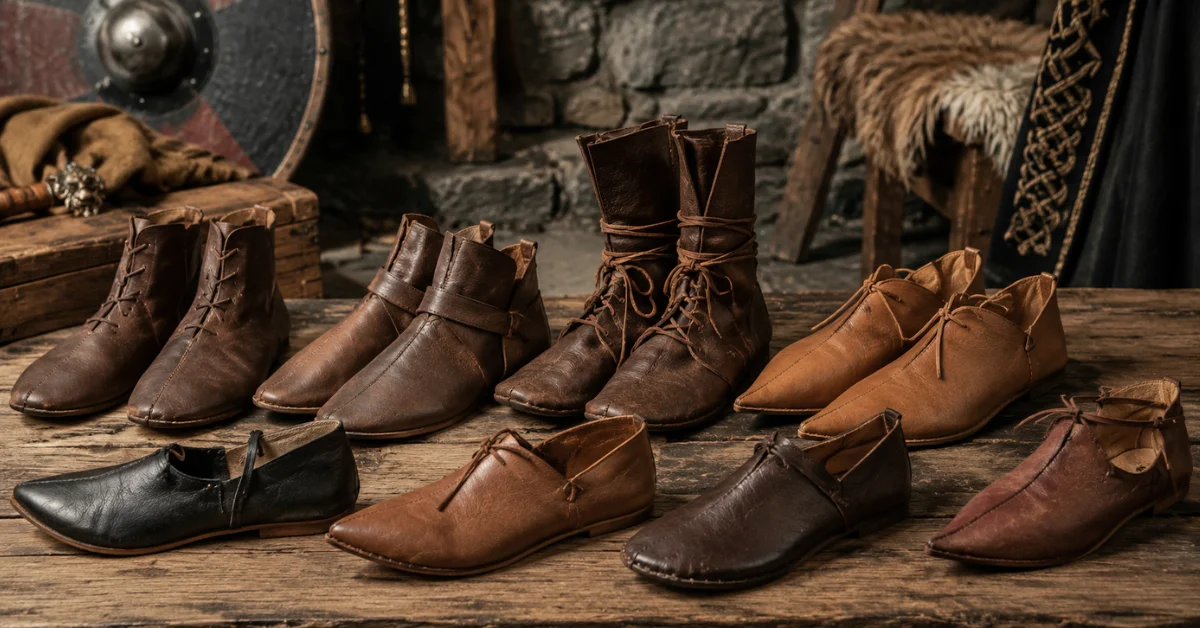
Medieval shoes were far more than simple foot coverings. They marked a person’s class, followed the fashions of their century, and were built using techniques that shoemakers still study today. If you have wondered what people wore on their feet between the 5th and 15th centuries, or you want an accurate pair for reenactment, LARP, or costume, this guide covers ground most other articles miss, including how this footwear was made, why one style caused a scandal in London, and how researchers know so much about shoes centuries old.
What Were Medieval Shoes Made Of?
Leather was the standard material across most of Europe for the entire era. Cattle, goat, and deer hide were all used, tanned with vegetable tannins made from bark rather than the chemical processes used now.
The construction method is what really sets this footwear apart from anything you would buy off a shelf today. Shoemakers relied on a technique called turnshoe construction:
- The upper and sole were stitched together inside out, with the seam on the outside of the leather.
- Once joined, the whole shoe was turned right side out.
- This hid the seam inside and left a smooth, flexible sole against the ground.
Turnshoes offered almost no rigid support and very thin soles, so wearers felt the ground far more directly than we do today. Some regions moved away from leather soles: in parts of the Low Countries, wood or woven bark held up better against wet ground, though most of the UK stayed with leather throughout.
Fastenings changed too. Early designs closed with simple leather laces wrapped around the ankle or tied across the top of the foot. Buckles and latchets did not become common until later, once metalworking grew more accessible and styles turned more elaborate.
How Shoemaking Changed Through the Middle Ages
It helps to think of this footwear in three rough phases, since shape, materials, and status symbolism shifted a great deal over nearly a thousand years.
Early Medieval (roughly 500 to 1000 AD)
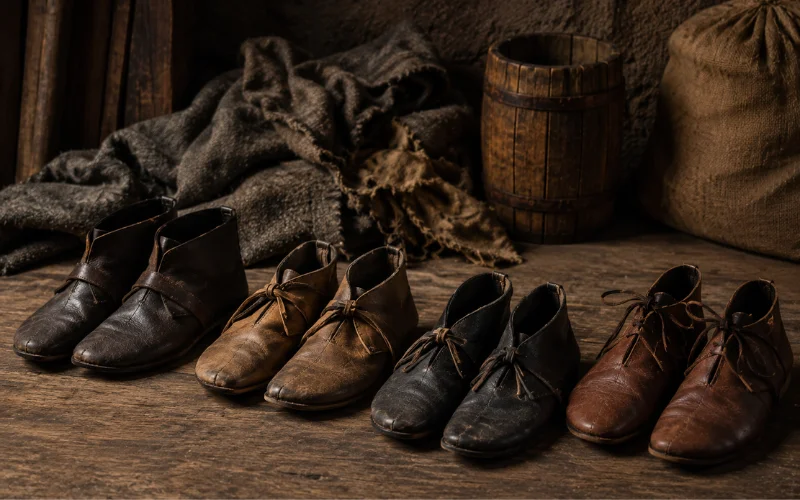
Designs were plain, low, and closed with simple ties. Function mattered more than fashion, and most people wore similar shapes regardless of class.
High Medieval (roughly 1000 to 1300 AD)
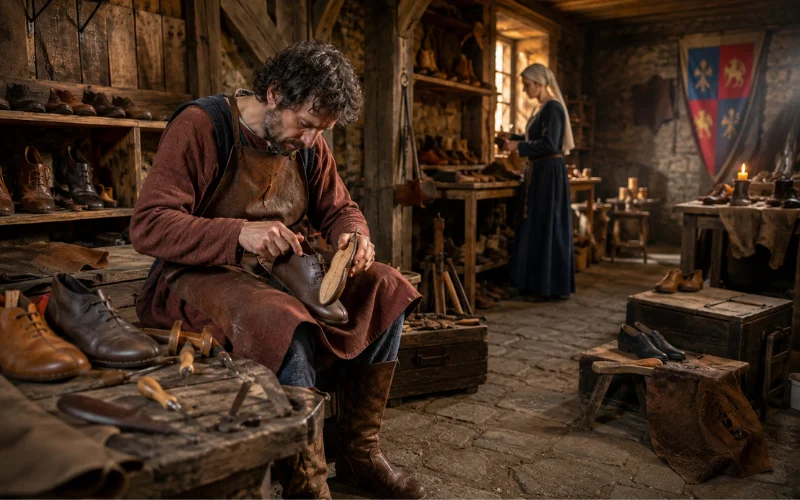
Shoemaking became a recognized trade with dedicated guilds. Styles began to reflect regional identity and modest status differences, though extreme fashion had not yet appeared.
Late Medieval (roughly 1300 to 1500 AD)
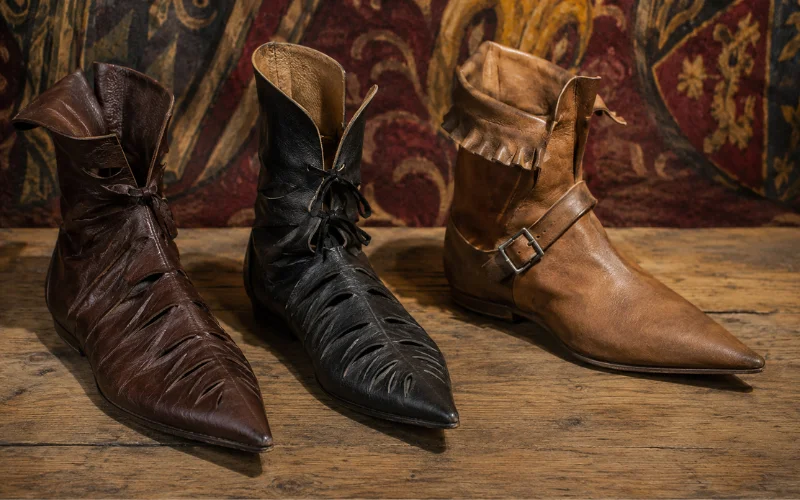
Footwear turned genuinely fashionable, sometimes to an extreme. Pointed toes, decorative slashing, and elaborate buckles appeared during this stretch, as clothing became a louder signal of wealth and rank.
The Poulaine: A Style That Caused a Scandal
No article on medieval shoes is complete without the poulaine, sometimes called the crackowe: the long, pointed style most people picture when they think of the Middle Ages. Its real history is stranger than most sellers mention.
The trend is generally believed to have started around 1340 in Krakow, Poland, a detail that gives the crackowe its name. From there it spread through the courts of Western Europe and grew more extreme with every decade. On some pairs, the toe extended as much as five inches past the wearer’s actual foot, stuffed with moss or wool to hold its shape.
The style became so extravagant that it triggered real legal action. In 1463, London banned pointed shoes worn by its wealthiest men once the fashion reached its most exaggerated lengths. Sumptuary laws like this one were common in the period, meant to stop lower classes from dressing like nobility and to rein in trends regulators saw as excessive.
There is also a compelling theory about why this look rose so fast. Some historians connect it to the years following the Black Death, when a huge share of Europe’s population had died and survivors responded with a burst of bold, expressive fashion, not unlike a post-crisis spending spree. Whether or not that theory fully explains it, the poulaine remains the clearest example of medieval shoes working as a status symbol rather than plain, practical footwear.
Men’s and Women’s Styles Differed More Than You’d Think
Reproduction sellers often treat historical footwear as one category, but men’s and women’s designs differed, particularly by the late medieval period.
Men’s designs
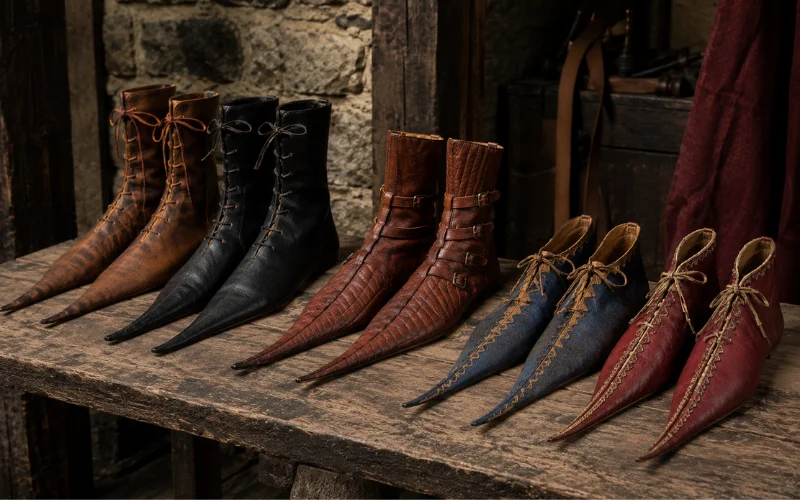
were more likely to carry extreme fashion statements, including the longest poulaine styles, since sumptuary laws often targeted male displays of wealth directly.
Women’s styles
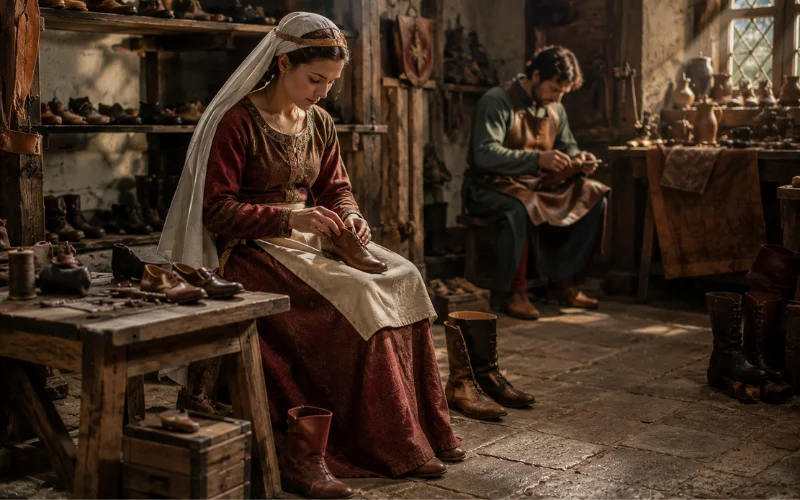
tended to stay closer to the ankle and were frequently hidden beneath long gowns, so surviving examples and artwork are rarer than what remains for men.
Both sexes shared the same core construction methods and materials, and class mattered more than gender when it came to leather quality, decoration, and fit.
Most articles skip this detail entirely, and it explains why surviving evidence leans toward men’s fashion.
How Historians Actually Know What They Looked Like
This is the part almost every other article leaves out: how do we actually know any of this?
Much of the evidence comes from archaeological digs in cities with wet, low-oxygen soil, which preserves leather remarkably well. London has produced an especially large number of finds, and museum collections built from these digs let researchers study stitching, sole wear, and repairs in physical detail rather than guessing from paintings alone.
Historians combine three types of evidence to reconstruct accurate styles:
- Archaeological finds: which reveal real stitching, sole shape, and wear patterns.
- Period artwork: including manuscript illustrations and effigies, which show color, decoration, and how footwear was worn with other clothing.
- Guild and legal records: including the sumptuary laws mentioned earlier, which reveal what was fashionable enough to need regulating.
A source drawing on all three is the difference between a costume prop and a genuinely accurate reproduction.
How to Choose Reproduction Medieval Shoes Today
If you are buying medieval shoes for reenactment, LARP, theater, or simply as an authentic accessory, a few details separate a good pair from a poor one.
- Check the construction method: Accurate reproductions use turnshoe construction, not a glued modern sole.
- Match the style to your century: A pointed poulaine looks out of place in an early medieval kit, and a plain ankle boot looks out of place in a flashy 15th century outfit.
- Look at the sole thickness: Originals had thin soles and little arch support. Many reproductions add a slightly thicker sole for comfort, which is reasonable, but it should be a deliberate choice, not a surprise.
- Ask about leather quality: Vegetable-tanned leather ages closer to the original than chrome-tanned leather and develops a better patina over time.
- Consider your actual use: A pair for occasional photos does not need the same durability as a pair worn all weekend at a reenactment event.
Buying a well-made pair of medieval shoes is an investment in comfort and authenticity, and a little research beforehand saves you from footwear that looks right in photos but falls apart in real use.
Caring for Your Medieval Shoes
Leather reproductions need more attention than modern synthetic shoes, but the upkeep is simple once it becomes a habit.
- Let wet pairs dry away from direct heat, since fast drying near a radiator will crack the leather.
- Condition the leather every few months with a natural balm.
- Store shoes stuffed with paper or a shoe form so they hold their shape.
- Avoid extended wear on rough pavement, since originals were built for dirt, grass, and cobblestone rather than concrete.
Frequently Asked Questions
1. What were medieval shoes made of?
Most were made from vegetable-tanned leather, though some regions used wood or woven bark for the sole in wetter climates.
2. Why did medieval shoes have such long, pointed toes?
The pointed style, known as the poulaine, became fashionable in the late medieval period, likely originating in Krakow around 1340, and grew more extreme as a status symbol among the wealthy.
3. Were they comfortable to walk in?
They were flexible but offered very little cushioning or arch support, since turnshoe construction used thin, soft soles rather than the layered soles found in modern shoes.
4. Did men and women wear different styles of footwear?
Yes. Men’s designs were more often the target of extreme, elaborate fashion, while women’s styles tended to stay simpler and were usually hidden beneath long gowns.
5. What is turnshoe construction?
It is a method where the shoe is sewn inside out and then turned right side out, hiding the seam and creating a smooth, soft sole with almost no rigid structure.
6. Why were pointed medieval shoes banned in some cities?
London banned extremely pointed shoes in 1463 as part of sumptuary laws, which were used to limit displays of wealth and keep clothing tied to social rank.
7. How do historians know what medieval shoes actually looked like?
Historians combine archaeological finds preserved in wet soil, period artwork, and guild or legal records to reconstruct accurate styles and construction methods.
8. Are modern reproduction medieval shoes historically accurate?
Quality varies widely. The most accurate reproductions use turnshoe construction and vegetable-tanned leather, while budget versions often use glued soles and modern tanning methods.
9. What should I look for when buying reproduction footwear for reenactment?
Match the style to your specific century, confirm the construction method, and check the leather quality before you buy.
10. How should I care for leather medieval shoes?
Dry them away from direct heat, condition the leather regularly, and store them with a shoe form to help them keep their shape.
Final Thoughts
Medieval shoes tell a bigger story than most people expect from a piece of footwear. They reveal how tightly fashion, law, and class were tied together in the Middle Ages, and the evidence buried in old city soil still shapes how historians and shoemakers understand the period. Whether you are drawn to this history, a reenactment kit, or the craftsmanship involved, knowing what made an original pair authentic will help you find a reproduction that earns the name.