You open your wardrobe and stare at a rail full of clothes — yet somehow, nothing seems to go together. Sound familiar? You’re not alone. Studies suggest the average person only wears around 20% of what they own. The rest just hangs there, untouched and unloved.
That’s exactly the problem an outfit maker is built to solve.
Whether you’re trying to make the most of what you already own, plan your looks ahead of time, or discover styles that actually suit you, an outfit maker gives you a clear, visual system to work with. No more morning panic. No more buying things you never wear. Just outfits that work — every time.
This guide covers everything you need to know: what an outfit maker is, how to use one effectively, what to look for in the best tools, and the styling principles that take your outfits from fine to genuinely great.
What Is an Outfit Maker?
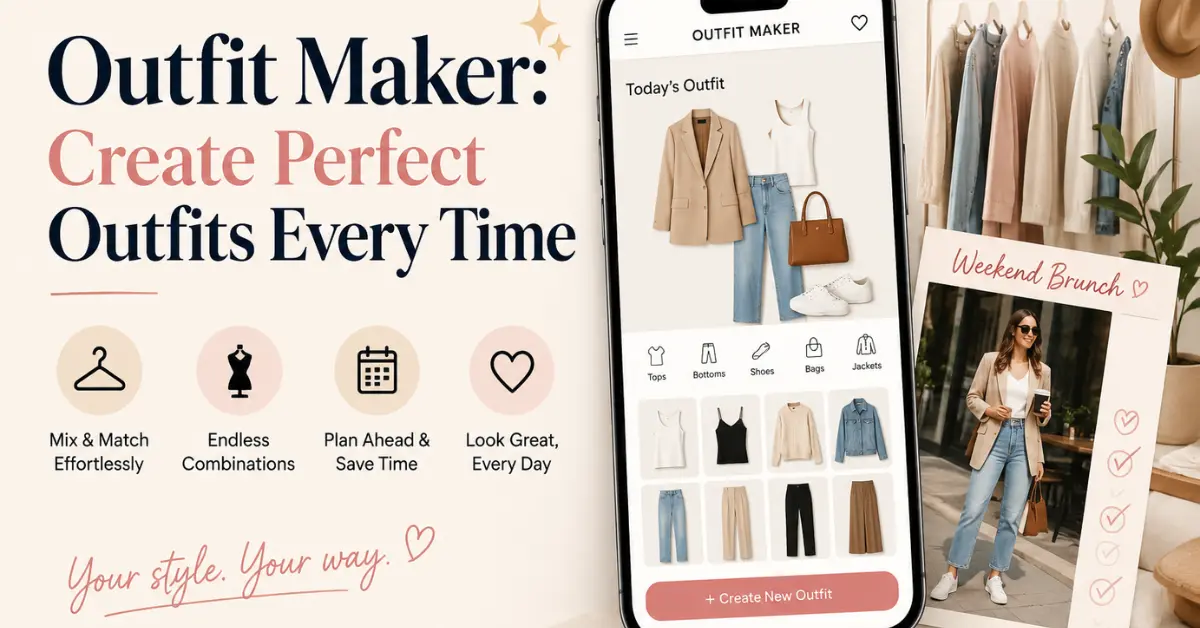
An outfit maker is a tool — either an app, a website, or even a physical method — that helps you plan, create, and save outfit combinations from your existing wardrobe. Think of it as a digital dressing room that lets you mix and match pieces without actually having to try them on.
A good outfit maker lets you:
- Upload photos of your real clothes
- Organize items by category (tops, bottoms, shoes, accessories)
- Drag and drop pieces together to build complete looks
- Save your best outfit combinations for future reference
- Plan outfits ahead of time for specific events, trips, or seasons
More advanced outfit maker tools now use artificial intelligence to suggest combinations based on what you already own, your personal style preferences, the weather, and even what you have coming up on your calendar. That shifts the experience from manual sorting to genuinely smart, personalized styling.
Why Use an Outfit Maker? The Real Benefits
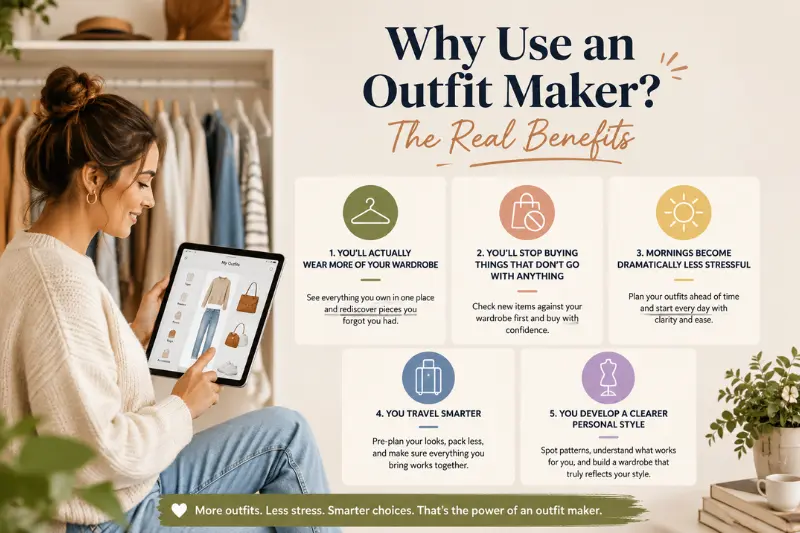
1. You’ll Actually wear more of your wardrobe
Most people unconsciously default to the same 5–10 outfits, cycling through familiar combinations and ignoring everything else. An outfit maker forces you to see your entire wardrobe at once, which naturally leads to rediscovering pieces you’d forgotten about.
2. You’ll stop buying things that don’t go with anything
Before adding a new item, you can check it visually against what you already own. If that gorgeous blazer doesn’t pair with a single thing in your wardrobe, you’ll see that before spending money on it — not after.
3. Mornings become dramatically less stressful
Planning outfits in advance — even just a few days ahead — removes decision fatigue from your morning routine. You wake up knowing exactly what you’re wearing. That’s a small thing that makes a surprisingly big difference to how the day starts.
4. You travel smarter
Packing for a trip becomes methodical instead of stressful. You can pre-plan every outfit for each day, ensuring you pack only what you’ll actually wear and that each item works in at least two or three different combinations.
5. You develop a clearer personal style
When you consistently build outfits and save what works, patterns emerge. You start to understand which colours you gravitate toward, which silhouettes feel most like you, and what’s actually missing from your wardrobe rather than what just seems appealing in a shop.
How to Use an Outfit Maker Effectively
Using an outfit maker well is a skill — and like most skills, a few good habits make a big difference.
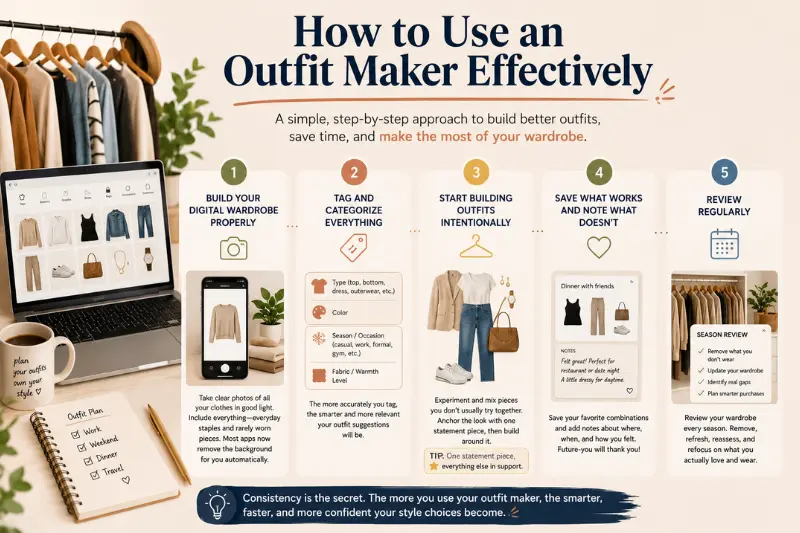
Step 1: Build your digital wardrobe properly
The foundation of any outfit maker is an accurate representation of what you own. Take photos of your clothes in good light, ideally against a neutral background. Most outfit maker apps now include background removal, which strips out the wall or floor and shows just the garment — this makes mixing and matching far easier visually.
Be thorough. Include the pieces you wear rarely as well as your everyday staples. The whole point is to see your wardrobe in full, so leave nothing out.
Step 2: Tag and categorize everything
Once your items are uploaded, take time to categorize them properly. A good outfit maker will let you tag items by:
- Type (top, bottom, dress, outerwear, shoes, bag, accessory)
- Color
- Season or occasion (casual, work, formal, gym)
- Fabric or warmth level
The more accurately you tag, the better your outfit suggestions will be — especially if you’re using an AI-powered outfit maker that filters recommendations by weather or event type.
Step 3: Start building outfits intentionally
Don’t just wait for the app to suggest something. Actively experiment. Pull out pieces you rarely wear and challenge yourself to build an outfit around them. Sometimes your “orphan” pieces — the ones that seemed like they’d never go with anything — just needed the right combination to come to life.
A useful rule of thumb when building outfits: anchor the look with one statement piece, then build around it. If you’re starting with a bold patterned shirt, keep everything else neutral. If your trousers are the hero, let the top play a supporting role.
Step 4: Save what works and note what doesn’t
Every time you get dressed and feel genuinely good in an outfit, record it. Most outfit maker apps let you save combinations with notes attached. Add context — “wore this to a dinner, felt overdressed” or “perfect for autumn walks” — so future-you has something to work with.
Step 5: Review regularly
Set aside time every season to review your digital wardrobe. Remove items you’ve donated or discarded, assess what you’ve actually worn versus what’s sat untouched, and identify the gaps that are genuinely worth filling. This is where the outfit maker pays for itself as a decision-making tool.
The Best Outfit Maker Features to Look For
Not every outfit maker is built the same. Here’s what separates genuinely useful tools from those that look impressive but don’t quite deliver:
AI outfit suggestions
The best outfit maker tools don’t just organize your wardrobe; they actively suggest what to wear. Look for AI that considers color coordination, occasion, season, and your personal wear history.
Background removal
Essential for making your digital wardrobe look clean and usable. Without it, photos of clothes cluttered with background noise are harder to mentally “try on.”
Virtual try-on
Some tools now allow you to place outfit combinations onto a model figure. This is particularly helpful for gauging proportions — whether a boxy jacket and wide-leg trouser combination will actually look balanced, for instance.
Outfit calendar
Planning functionality that lets you assign outfits to specific days. Invaluable for travel packing and for those who like to plan their week in advance.
Wear tracking and analytics
A feature that shows you how often you wear each item. Seeing that a coat you loved has been worn zero times in six months is exactly the kind of honest feedback that leads to a better wardrobe.
Accessibility across devices
The best outfit maker experience should work on your phone when you’re shopping, on your tablet when you’re planning, and ideally on your desktop or laptop too.
Outfit Maker for Different Occasions
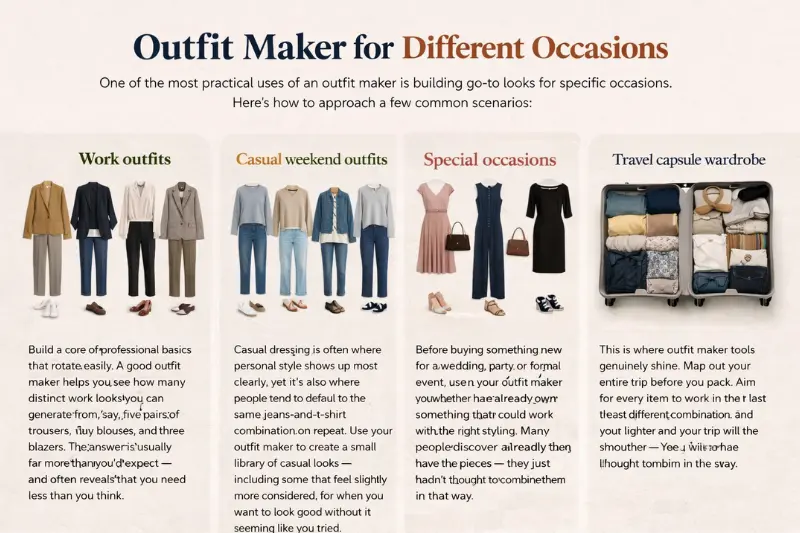
One of the most practical uses of an outfit maker is building go-to looks for specific occasions. Here’s how to approach a few common scenarios:
Work outfits
Build a core of professional basics that rotate easily. A good outfit maker helps you see how many distinct work looks you can generate from, say, five pairs of trousers, four blouses, and three blazers. The answer is usually far more than you’d expect — and often reveals that you need less than you think.
Casual weekend outfits
Casual dressing is often where personal style shows up most clearly, yet it’s also where people tend to default to the same jeans-and-t-shirt combination on repeat. Use your outfit maker to create a small library of casual looks — including some that feel slightly more considered, for when you want to look good without it seeming like you tried.
Special occasions
Before buying something new for a wedding, party, or formal event, use your outfit maker to see whether you already own something that could work with the right styling. Many people discover they already have the pieces — they just hadn’t thought to combine them in that way.
Travel capsule wardrobe
This is where outfit maker tools genuinely shine. Map out your entire trip before you pack. Aim for every item to work in at least three different outfit combinations. Your suitcase will be lighter and your trip will be smoother.
The Styling Principles That Make Outfits Actually Work
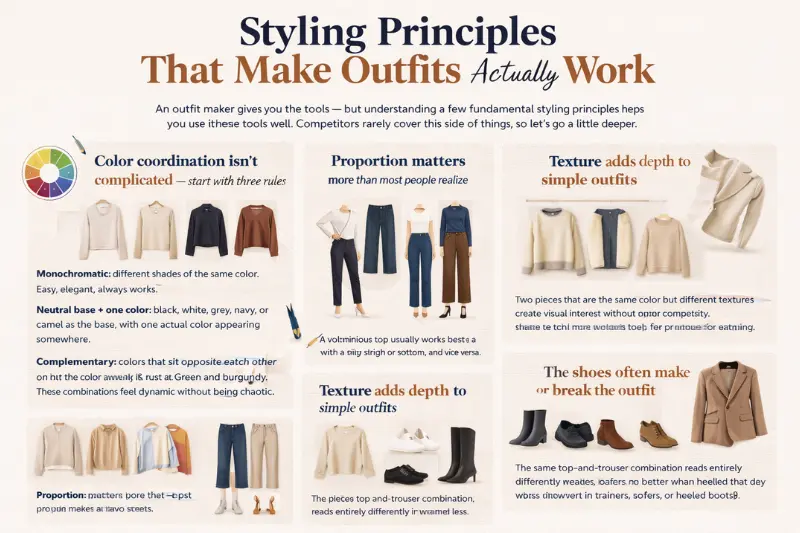
An outfit maker gives you the tools — but understanding a few fundamental styling principles helps you use those tools well. Competitors rarely cover this side of things, so let’s go a little deeper.
Color coordination isn’t complicated — start with three rules
For most people, most of the time, these three approaches cover the majority of outfits:
- Monochromatic: different shades of the same color. Easy, elegant, always works.
- Neutral base + one color: black, white, grey, navy, or camel as the base, with one actual color appearing somewhere.
- Complementary: colors that sit opposite each other on the color wheel. Navy and rust. Green and burgundy. These combinations feel dynamic without being chaotic.
Proportion matters more than most people realize
A voluminous top usually works best with a slim or straight bottom, and vice versa. This isn’t a rigid rule — fashion regularly breaks it with great results — but it’s a useful starting point when you’re unsure why an outfit isn’t quite landing.
Texture adds depth to simple outfits
Two pieces that are the same color but different textures — a cashmere jumper and wool trousers in the same cream shade, for instance — create visual interest without any complexity. Mixing textures is one of the most underused tools in most people’s wardrobes.
The shoes often make or break the outfit
An outfit maker that includes shoes in the planning process — rather than treating them as an afterthought — will produce noticeably better results. The same top-and-trouser combination reads entirely differently in trainers, loafers, or heeled boots.
Fit is non-negotiable
The most important truth in styling: clothes that fit well always look better than clothes that don’t, regardless of brand, price, or trend. If you’re uploading items to an outfit maker that don’t quite fit, note that honestly. The tool can help you plan outfits, but it can’t override the reality of how something fits on your actual body.
Outfit Maker for Men: A Specific Note
Most styling content — and most outfit maker tools — skew female. But men benefit from outfit planning just as much, and in some ways the process is simpler because the building blocks are more defined.
A men’s outfit maker works especially well for:
- Building a professional wardrobe rotation without buying too much
- Planning business-casual looks that don’t feel boring
- Learning which colors work together (navy and grey almost always works; brown and black very rarely does)
- Understanding fit — the single biggest driver of how good a men’s outfit looks
If you’re a man using an outfit maker for the first time, start with a core capsule: a few pairs of well-fitting trousers in neutral colors, a handful of shirts and tops, one or two versatile outerwear pieces, and two or three shoe options. The outfit combinations from even this modest foundation are more numerous than you’d expect.
Common Outfit Maker Mistakes to Avoid
Even with the right tool, a few habits will undermine your results:
Only uploading your favourite pieces
The whole value of an outfit maker is seeing your full wardrobe. If you cherry-pick, you’ll keep cycling through the same familiar looks.
Ignoring accessories
Accessories — a belt, a scarf, earrings, a watch — often make the difference between an outfit that looks incomplete and one that looks deliberate. Include them in your outfit maker from the start.
Saving outfits but never reviewing them
The library of saved looks only has value if you actually use it. Check it before deciding you have “nothing to wear.”
Using an outfit maker as an excuse to shop more
The opposite should be true. A well-used outfit maker should reveal the outfits hiding in what you already own — and reduce the impulse to add more before you’ve genuinely used what’s there.
Frequently Asked Questions
Is an outfit maker the same as a virtual wardrobe?
They overlap, but they’re not identical. A virtual wardrobe is primarily a catalogue of everything you own. An outfit maker is a tool for actively building and saving combinations. The best apps combine both functions — a full wardrobe catalogue with outfit creation and planning built on top.
Do I need a lot of clothes for an outfit maker to be useful?
No — in fact, an outfit maker is often more valuable if you have a smaller, focused wardrobe. The tool helps you see exactly how many combinations you can generate from a limited number of pieces, which is the whole philosophy behind a capsule wardrobe.
Can an outfit maker help if I have no sense of style?
Absolutely. This is one of the clearest benefits. By experimenting visually in the app — without physically pulling everything off hangers — you start to develop an eye for what works and what doesn’t. Over time, that builds genuine style instinct.
Are outfit maker apps free?
Many offer a free tier with a limited number of wardrobe items or outfit saves. For most casual users, a free plan is sufficient. Those who want unlimited storage, AI suggestions, and advanced features typically pay between $5–$10 a month, depending on the app.
What’s the difference between an AI outfit maker and a basic one?
A basic outfit maker is a manual drag-and-drop tool — you build the outfits yourself. An AI outfit maker actively suggests combinations, taking into account color theory, occasion, weather data, and your personal wear history. The AI layer doesn’t replace your judgment, but it significantly accelerates the process and often surfaces combinations you wouldn’t have thought of yourself.
The Bottom Line
An outfit maker is one of the most practical tools you can add to your daily routine — not because fashion matters more than other things, but because how you dress affects how you feel, and a good system removes friction from that daily decision.
The best outfit maker for you is the one you’ll actually use consistently. Start simple: photograph what you own, build a handful of outfits, and save the ones that work. From there, the habit builds naturally — and so does your sense of what your personal style actually looks like.
Your wardrobe is probably already full of great outfits. You just haven’t met all of them yet.