If you’ve spent any time on fashion TikTok or scrolling past yet another “10 Quiet Luxury Brands to Know” listicle, you’ve probably noticed something: almost every article says the exact same thing. Logos are out. Cashmere is in. Blame Succession. Blame Gwyneth Paltrow’s ski trial. Buy The Row.
That’s not wrong, exactly. But it’s also not the full picture, and it’s the reason most “what is quiet luxury” content feels like it was copy-pasted from the same three sources. So here’s the version with the parts everyone else skips: where the term actually comes from, why it’s not as democratic as it’s marketed to be, how to build the look at any budget, and the uncomfortable question almost nobody in fashion media wants to ask — is quiet luxury just a new way for the wealthy to gatekeep, dressed up in beige?
What Is Quiet Luxury?
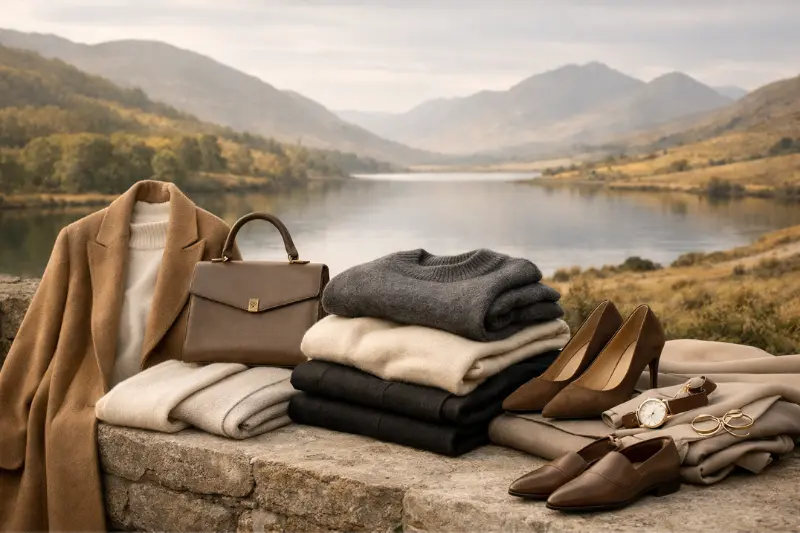
Quiet luxury is a style philosophy built around understated, high-quality clothing that signals taste and craftsmanship rather than brand recognition. Instead of a visible logo or instantly identifiable pattern, the “signal” is in the details: the way a wool coat drapes, the weight of a cashmere sweater, the precision of a seam.
In practice, that means:
- Muted, tonal color palettes — camel, cream, navy, charcoal, black, soft grey
- Natural, high-grade fabrics — cashmere, merino wool, silk, fine cotton, full-grain leather
- Clean, tailored silhouettes with minimal embellishment
- No visible branding, or branding so subtle it only registers with people who already know what they’re looking at
- Longevity over trend-chasing — pieces designed to be worn for a decade, not a season
The shorthand you’ll see everywhere is “the opposite of logo mania.” That’s accurate but incomplete. Quiet luxury isn’t really about the absence of a logo — it’s about replacing one status signal (a recognizable brand mark) with a more exclusive one (the ability to recognize quality without a label telling you what it is). It’s still status signaling. It’s just signaling to a smaller, more informed audience.
Where the Term Actually Came From
Most articles credit Succession and stop there. The fuller timeline looks like this:
The concept predates the name. Sociologists and marketing researchers have studied “inconspicuous consumption” since at least the early 2010s — long before “quiet luxury” was a hashtag. A widely cited 2014 paper by Eckhardt, Belk, and Wilson in the Journal of Marketing Management described exactly this phenomenon: wealthy consumers deliberately choosing understated goods specifically because overt logos had become associated with aspirational, rather than truly exclusive, wealth. In other words, by the 2010s, logos had become so widely accessible (via outlet stores, resale markets, and counterfeit production) that they stopped working as effective status markers for people at the very top.
Succession popularized it, but didn’t invent it. When the show’s fourth season aired in early 2023, Google Trends data shows a sharp, immediate spike in searches for “quiet luxury” — almost entirely traceable to one scene: Tom Wambsgans mocking a Burberry tote as “ludicrously capacious.” The internet ran with it. Stylist accounts cataloguing the Roy family’s wardrobe (unbranded Loro Piana, Zegna, Brunello Cucinelli) sprang up overnight.
The Gwyneth Paltrow trial sealed it. A few weeks after that episode aired, Paltrow’s 2023 Utah ski-collision civil trial put her in front of cameras daily, wearing what commentators described as a masterclass in understated dressing — Celine boots, neutral cashmere, no obvious logos. The timing made it feel like proof the trend was already everywhere among people who’d never watched the show.
The economics underneath it are older and less glamorous than a TV plot. Quiet luxury tends to surge during and after periods of economic anxiety or visible wealth inequality, when overt displays of spending start to look tone-deaf rather than aspirational. You can see versions of this pattern after 2008 and again post-pandemic. It’s less “a new aesthetic was born” and more “the wealthy adjusted how they signal wealth because the old way stopped working socially.”
This matters for you as a reader because it explains something most guides gloss over: quiet luxury isn’t actually new, and it isn’t actually about minimalism for its own sake. It’s a recurring response to logo fatigue among people who already have money. Understanding that helps you separate the parts of the trend that are genuinely useful to you (better-made basics, less impulse buying) from the parts that are mostly marketing.
Quiet Luxury vs. Minimalism vs. “Old Money” Style — They’re Not the Same
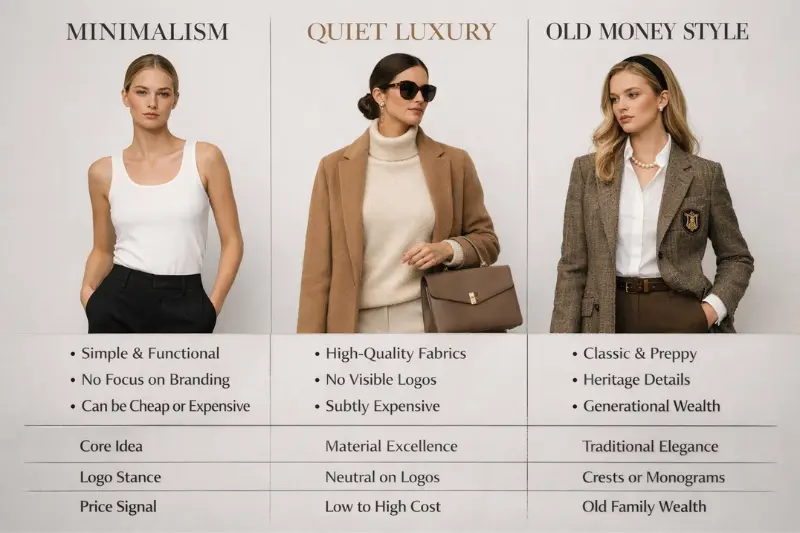
These three terms get used interchangeably online, and that’s causing real confusion. Here’s the actual distinction:
| Core idea | Logo stance | Price signal | |
|---|---|---|---|
| Minimalism | Fewer items, simple shapes | Neutral — not the point | Can be cheap or expensive |
| Old money style | Inherited-looking, traditional, often preppy | Avoids trend logos but can include heritage crests | Assumes generational wealth, not necessarily current high spend |
| Quiet luxury | High cost-per-wear, exceptional materials, no visible branding | Actively avoids logos as a strategy | Specifically expensive — the “quiet” is the point precisely because it’s costly |
The distinction matters practically: if you’re shopping for “old money style,” you’re looking for tweed, equestrian motifs, and tradition. If you’re shopping for “quiet luxury,” you’re prioritizing fabric quality and construction above all else, regardless of whether the silhouette looks preppy, minimalist, or modern. A lot of guides conflate these and send readers shopping for the wrong thing.
The Honest Critique: Is Quiet Luxury Actually Inclusive?
This is the part competitor content almost universally skips, probably because most of those articles are funded by affiliate links to $2,000 coats.
The marketing language around quiet luxury — “anti-bling,” “buy less, buy better,” “it’s about quality, not money” — implies anyone can do it. Just buy fewer, better things. But the entire premise rests on materials and construction that are inherently expensive to produce. A genuinely good cashmere sweater costs what it costs because of yarn quality, knitting gauge, and finishing — there’s a real cost floor that doesn’t have a workaround. The “secret club” framing that several major outlets use unironically (the idea that recognizing The Row signals you’re “in the know”) is, functionally, just exclusivity with better PR.
That doesn’t mean the aesthetic is inaccessible — a $40 COS sweater can look identical to one costing ten times more from across a room. But the actual quiet luxury proposition (heirloom-quality pieces meant to last 10+ years) does have a real price floor that no styling trick erases. Being honest about that distinction — look vs. substance — will make you a smarter shopper than chasing the brand list.
How to Build the Quiet Luxury Look at Any Budget
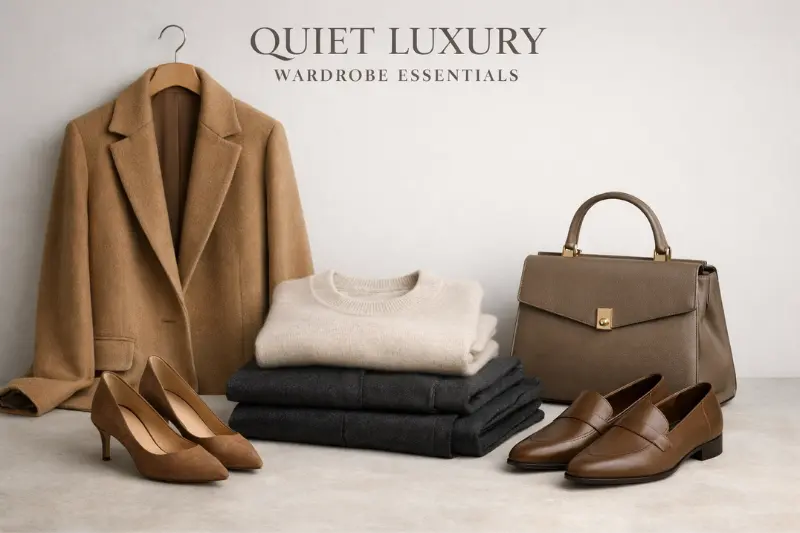
Here’s the practical part most listicles bury under affiliate links. Build from the foundation up, regardless of budget tier.
The five foundational pieces, in order of impact
- A well-cut wool or wool-blend coat in camel, navy, or charcoal. This is the single highest-impact item — it’s worn over everything else and is the first thing people notice.
- A cashmere or fine merino crewneck or cardigan. Check the gauge (tighter knit = more durable) and the fiber grade if listed (Grade A cashmere is longer-staple and pills less).
- Tailored trousers in a neutral — wool or a wool-blend that holds its shape without shine.
- A structured leather bag with minimal hardware. Function and shape matter more than brand here.
- Leather shoes or boots in a simple, almost architectural shape — no obvious branding on the sole or hardware.
What to actually look for when shopping (the part nobody explains)
- Fabric weight and drape: hold the garment up — quality wool and cashmere fall in a heavy, fluid line rather than sitting stiffly.
- Seam finishing: turn the garment inside out. French seams, bound edges, and no visible fraying are good signs even on lower-priced pieces.
- Buttons and zippers: real horn, metal, or shell buttons (not glued-on plastic) and smooth-gliding zippers are reliable tells of build quality, independent of brand.
- Pilling test, if you can: rub a small interior patch with your fingers — instant pilling signals a lower-grade fiber blend regardless of price.
- Color, not print: solid, slightly muted colors photograph and age better than anything seasonal or printed. If in doubt, buy the color that already exists in your closet’s palette.
Quiet luxury at three price points
Entry ($30–150): COS, Uniqlo (specifically their wool and cashmere lines), Everlane, J.Crew, Mango’s tailored pieces, Massimo Dutti.
Mid-tier investment ($150–600): Toteme, Arket, Vince, Theory, A.P.C., Ralph Lauren’s better lines.
Designer ($600+): The Row, Khaite, Max Mara, Jil Sander, Loro Piana, Brunello Cucinelli.
You don’t need to commit to one tier. The most authentically “quiet luxury” closets mix all three — a $4,000 Max Mara coat over a $40 COS turtleneck is, genuinely, how a lot of the people this trend describes actually dress.
Quiet Luxury for Men
This gets thin coverage almost everywhere except brand sites trying to sell you something, so here’s the breakdown specifically for menswear:
- Outerwear: unbranded wool overcoats, field jackets without obvious logos — Loro Piana, Brunello Cucinelli, and mid-tier options like Sandro or COS Men.
- Knitwear: merino or cashmere crewnecks and half-zips in navy, grey, oatmeal — avoid anything with a large embroidered logo on the chest.
- Tailoring: a single well-made navy or grey suit fits the quiet luxury brief far better than three trend-driven ones.
- Accessories: a leather belt with a minimal buckle, a simple leather watch strap, and a structured leather bag or briefcase (Carl Friedrik and similar brands built entire product lines around exactly this) do more for the aesthetic than any single clothing item.
Quiet Luxury Beyond Fashion: Home and Interiors
The same logic has spread to interior design, and it’s worth a brief mention since most fashion-focused guides ignore it entirely:
- Neutral, tonal palettes (cream, taupe, soft grey) instead of bold statement colors
- Natural materials — linen, raw wood, stone, unlacquered brass — left visible rather than disguised
- Investment furniture pieces meant to last decades rather than trend-driven decor
- An absence of visible branding on furniture and accessories — the same “no logo” principle applied to a sofa or a lamp
The underlying idea is identical to the fashion version: the value is in the material and craftsmanship, not in a recognizable name.
Quick Reference: Quiet Luxury Shopping Checklist
- Does the color work with at least 3 other things I already own?
- Is the fabric natural fiber (wool, cashmere, silk, cotton, leather) or a high-quality blend?
- Are seams, buttons, and hardware finished well on close inspection?
- Is there a visible logo, and if so, is it subtle enough to be missed by someone not already familiar with the brand?
- Would I still want this in five years, regardless of trend cycles?
If you can check all five, you’re shopping quiet luxury correctly — regardless of what it cost.
Frequently Asked Questions
Is quiet luxury just a rebrand of minimalism? No. Minimalism is about quantity and simplicity of shape. Quiet luxury is specifically about material quality and cost-per-wear, and can include more ornate silhouettes as long as the construction and fabric are high-end.
Do I need designer brands to do quiet luxury correctly? No. The aesthetic is achievable at almost any budget; the genuine longevity and fabric quality that define true quiet luxury do have a real cost floor, but you can absolutely get 80% of the look with mid-range and even fast-fashion pieces if you shop carefully for fabric and construction.
Is quiet luxury still relevant, or has it peaked? Search interest spiked sharply in 2023 and has settled into a steadier baseline since — it’s moved from “viral trend” to “established style category,” similar to how “capsule wardrobe” or “old money style” have become permanent fixtures in fashion vocabulary rather than passing fads.
What’s the difference between quiet luxury and stealth wealth? They’re used interchangeably in most coverage, though “stealth wealth” leans slightly more toward the lifestyle and behavior (where you vacation, how you talk about money) while “quiet luxury” is more specifically about the clothing and objects themselves.
Building a quiet luxury wardrobe isn’t about memorizing a brand list — it’s about training your eye to recognize fabric quality and construction over logos. Start with one foundational piece, learn what good wool or cashmere actually feels like, and the rest of the shopping decisions get a lot easier.