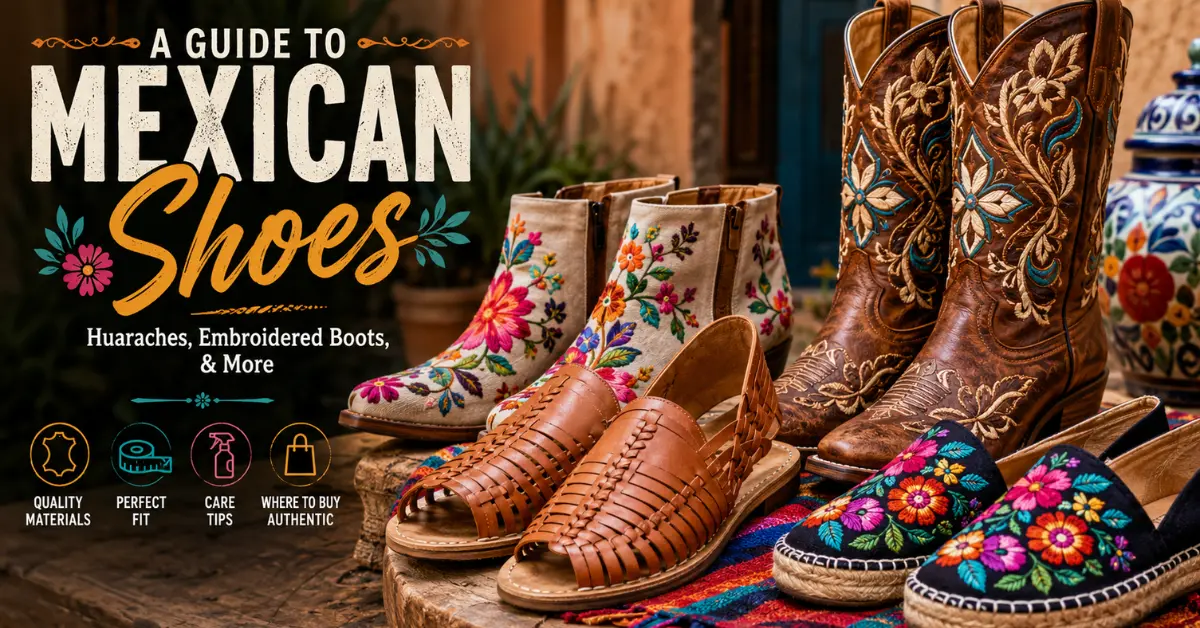
If you’ve ever slipped on a pair of handwoven leather huaraches and felt the difference — the way they mold to your foot, breathe in the heat, and somehow look good with everything — you already understand why Mexican shoes have earned fans across the world.
But “Mexican shoes” covers a lot of ground. There are sandals braided by hand in Michoacán, embroidered boots from Guanajuato, hand-painted sneakers inspired by Otomi textiles, and moccasins passed down through indigenous craft traditions. Knowing the difference helps you choose wisely, buy authentically, and take care of what you get.
This guide covers every major style, what makes each one special, how to find your size, and what to watch for when buying online.
What Makes Mexican Shoes Different?
The short answer: the hands that make them and the materials they use.
Most Mexican footwear sold through specialty brands is still handcrafted in small workshops — called talleres — often in the same family or community for generations. Unlike mass-produced shoes, each pair is shaped and finished by a person, not a machine. That means slight variations in color, texture, and weave are a feature, not a defect. They’re the signature of the artisan.
The other defining quality is material sourcing. Traditional Mexican shoemakers use genuine vegetable-tanned or chrome-tanned leather, natural rubber soles tapped from trees, and dyes derived from plants and minerals rather than synthetic chemicals. These choices affect how the shoe feels, how long it lasts, and how it ages — leather that’s tanned with plant extracts, for example, develops a rich patina over time that synthetic leather simply cannot replicate.
The Main Types of Mexican Shoes
Huaraches
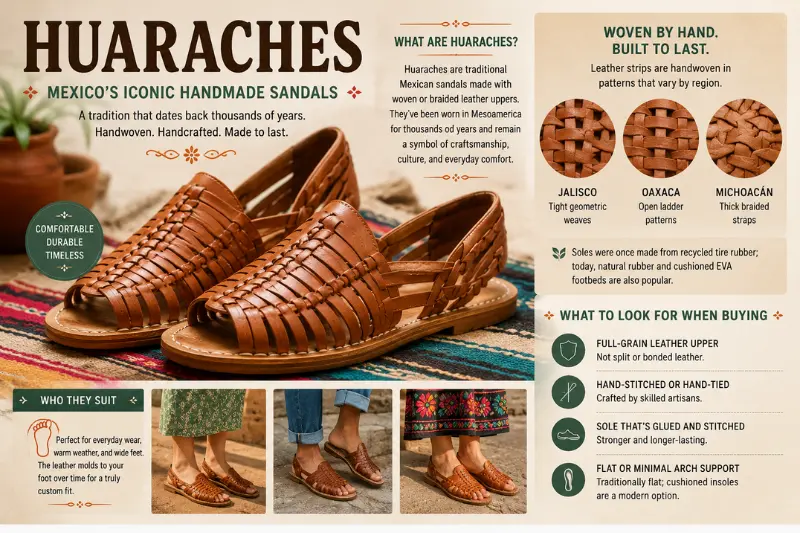
Huaraches are the most iconic Mexican shoe, and for good reason — they’ve been worn in Mesoamerica for thousands of years. Pre-Columbian murals and artifacts show sandals strikingly similar to the ones made today.
A true huarache is defined by its woven or braided leather upper. Strips of leather are interlaced by hand in patterns that vary by region: tighter geometric weaves from Jalisco, open ladder patterns from Oaxaca, thick braided straps from Michoacán. The sole was traditionally made from recycled tire rubber — a practical adaptation from the mid-20th century — though most contemporary makers now use natural rubber or cushioned EVA footbeds.
Who they suit: Huaraches work equally well as casual everyday footwear and as a statement piece for summer dressing. They’re particularly popular for people with wide feet because the leather stretches and conforms to foot shape over time.
What to look for when buying:
- Full-grain leather upper (not split or bonded leather)
- Hand-stitched or hand-tied construction at the sole
- A sole that’s glued and stitched — not just glued
- Flat or minimal arch support (huaraches are traditionally flat; cushioned insoles are a modern addition some brands offer)
Common styles: Classic closed-toe, fisherman (enclosed toe with woven sides), open-toe sandal, platform huarache, slip-on mule style, lace-up ankle wrap.
Mexican Embroidered Shoes and Boots
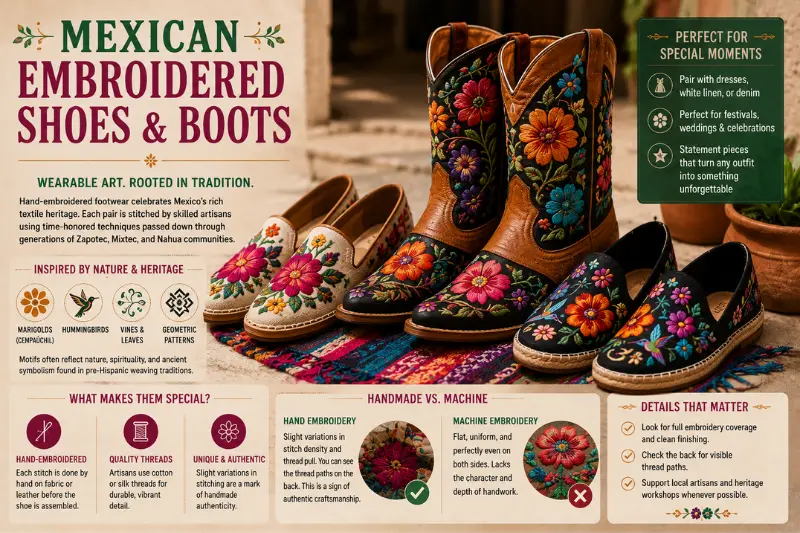
If huaraches represent the sandal tradition, embroidered footwear represents the textile tradition of Mexico’s highlands and southern regions. These are shoes and ankle boots covered in hand-embroidered floral patterns, using techniques that originated with indigenous Zapotec, Mixtec, and Nahua communities.
The embroidery is done on fabric or leather uppers before the shoe is assembled. Common motifs include marigolds (cempasúchil), hummingbirds, vines, and geometric patterns derived from pre-Hispanic weaving codes. The threads are typically cotton or silk, and the most detailed work is done on a frame stitch by stitch.
Who they suit: These shoes are statement pieces. They pair naturally with dresses, white linen, or denim, and work well for festivals, weddings, and occasions where plain footwear would be an afterthought.
What separates quality from cheap: Machine embroidery is flat and uniform; hand embroidery has slight irregularities in density and thread pull — that unevenness is a sign of authenticity. Check the back of the fabric: in hand embroidery, you’ll see the thread paths on the inside.
Mexican Sneakers (Tenis Artesanales)
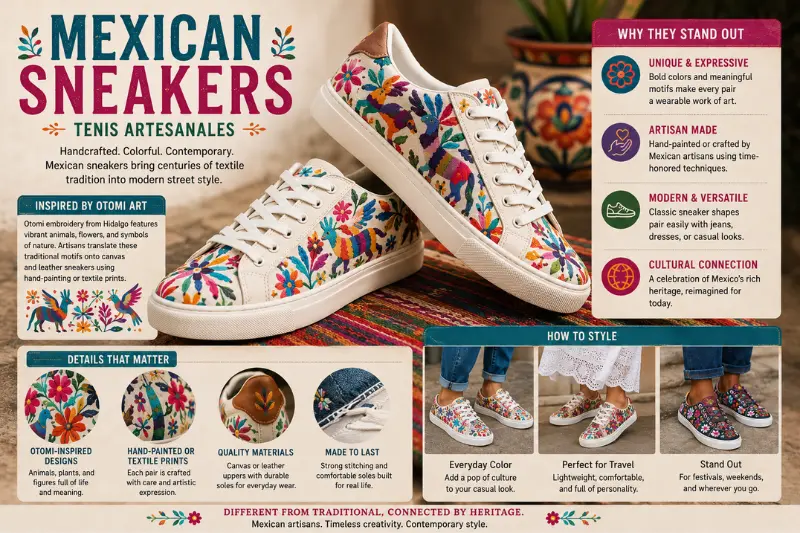
A more recent category that’s grown quickly: canvas or leather sneakers decorated with hand-painted designs or Otomi-inspired textile prints. Otomi embroidery — traditional to the Otomi people of Hidalgo — features brightly colored animals, plants, and figures in a dense, layered style. Brands and artisans have adapted this aesthetic onto classic sneaker silhouettes.
These aren’t the same as traditional footwear, but they’re part of the same creative lineage: Mexican artisans applying regional craft to contemporary forms.
Moccasins and Leather Flats
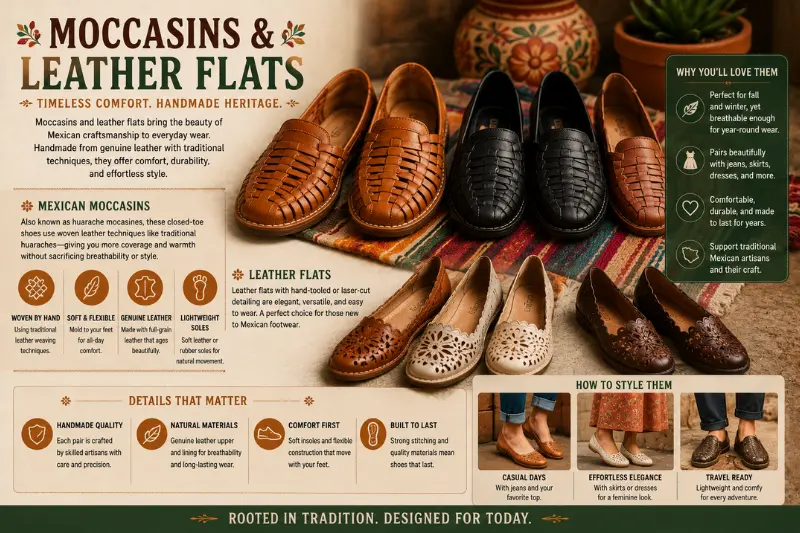
Mexican moccasins (sometimes called huarache mocasines) are closed-toe leather shoes with soft soles, often made with the same woven leather techniques as sandals. They’re particularly popular in fall and winter, or for people who love the aesthetic of Mexican footwear but want more coverage.
Leather flats with hand-tooled or laser-cut detailing are another popular category — simpler in construction than huaraches but still handmade, and often easier for people new to Mexican footwear to wear.
Cowboy and Charro Boots
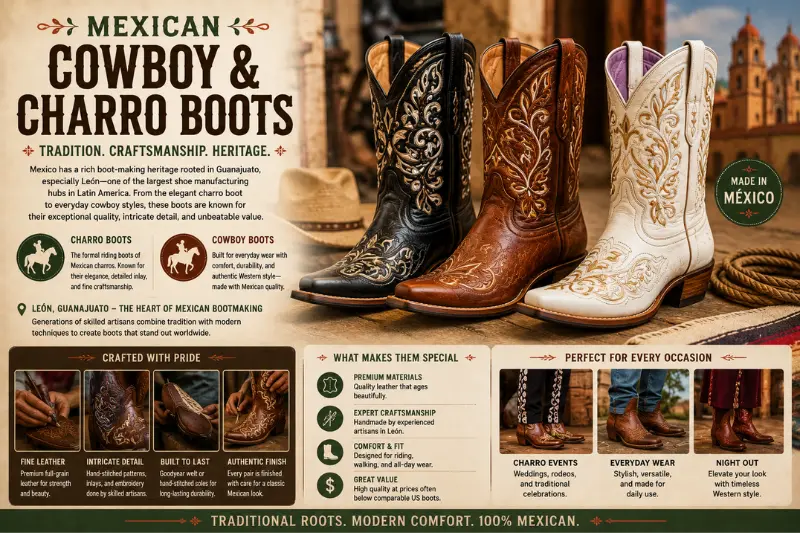
Mexico has its own deep boot-making tradition, centered in the state of Guanajuato and cities like León — one of the largest shoe manufacturing hubs in Latin America. Charro boots, the formal riding boots of Mexican equestrian culture, are among the most elaborately crafted leather boots made anywhere in the world, with pointed toes, stacked heels, and intricate inlay or stitching work. León also produces excellent everyday cowboy-style boots at prices often significantly below comparable US-made boots.
Materials: What You’re Actually Buying
Understanding materials is the single most important thing you can do before spending money on Mexican shoes.
Genuine full-grain leather is the top tier — taken from the outermost layer of the hide, it’s the most durable and develops character with wear. Almost all serious artisan brands use this.
Split leather (sometimes called “genuine leather” confusingly) comes from the inner layers of the hide after the top grain is separated. It’s weaker, doesn’t age as well, and is often used to keep costs down. Check brand descriptions carefully.
Natural rubber soles are ideal: flexible, grippy, and biodegradable. Many traditional huaraches used recycled tire rubber, which is also excellent. Cheaper alternatives use synthetic TPR or EVA foam — fine for comfort but less durable.
Vegetable-based dyes are more eco-friendly and tend to produce slightly more muted, natural-looking colors. Synthetic dyes produce more vivid colors but can bleed in wet conditions.
Sizing: How Mexican Shoes Fit
This is one of the most common pain points when buying Mexican shoes online, so it’s worth covering in detail.
Huaraches generally run true to US size — but because leather stretches, some makers recommend sizing down half a size if you’re between sizes. The leather will conform to your foot within a few wears.
Wide-toe-box styles have more room across the ball of the foot. If you have wide feet or high arches, look specifically for these.
Most Mexican brands use Mexican sizing (MX), which aligns approximately with US sizing for women. Men’s sizing can differ slightly. Here’s a rough guide:
| US Women’s | US Men’s | Mexican (MX) |
|---|---|---|
| 5 | — | 22–22.5 |
| 6 | — | 23 |
| 7 | 5 | 24 |
| 8 | 6 | 25 |
| 9 | 7 | 26 |
| 10 | 8 | 27 |
| 11 | 9 | 28 |
| 12 | 10 | 29 |
When in doubt, measure your foot from heel to longest toe in centimeters — that number is your MX size (e.g., 25 cm = MX 25).
How to Break In Mexican Leather Shoes
New leather huaraches or flats can feel stiff. Here’s how to ease them in without discomfort:
Wear them around the house first. Start with 20–30 minutes indoors, then gradually increase. Leather softens fastest with body heat and movement.
Use a leather conditioner before the first wear. A light coat of neatsfoot oil or a product like Leather Honey softens the fibers and prevents cracking. Avoid petroleum-based products.
Don’t soak them to break them in. The old “wear wet shoes until dry” method works but stresses the leather unnecessarily and can cause shrinkage in some constructions.
With woven huaraches, the weave itself will relax and open slightly. This is normal and desired — it’s what creates the custom fit huarache wearers love.
How to Care for Mexican Shoes
Leather sandals and huaraches:
- Wipe with a damp cloth after wear to remove dust and sweat
- Condition with a leather cream or oil every 4–6 weeks, more often in dry climates
- Store away from direct sunlight, which causes leather to dry and crack
- If they get wet, let them dry naturally away from heat sources (radiators and direct sun warp the leather)
Embroidered shoes:
- Avoid getting the embroidered sections wet — water can cause dye bleed
- Spot clean only with a damp cloth; never machine wash
- Store in a cotton dust bag, not plastic
Rubber soles:
- Clean with a mild soap and brush
- Check the bond between sole and upper periodically; a cobbler can resole or re-glue if needed — and it’s worth doing, since the uppers often outlast the soles
What to Avoid When Buying Mexican Shoes Online
The rise in demand for authentic Mexican footwear has also brought a wave of imitation products — mass-produced in factories, often overseas, using the aesthetic without the craft.
Here’s how to spot the real thing:
Look for specifics about where and how the shoes are made. Authentic brands name the region, the artisans, or the cooperative. Vague language like “inspired by Mexican tradition” is a red flag.
Check the photos carefully. Handmade shoes have slight variations — slightly uneven stitching, natural grain variation in the leather, minor color differences between pairs. If every shoe looks identical, it was likely machine-made.
Read the materials description. “PU leather,” “vegan leather,” or “synthetic upper” are all code for plastic. These products won’t breathe, won’t mold to your foot, and won’t age gracefully.
Verify the brand’s story. Legitimate artisan brands will have information about their makers — photos, names, the region they work in, the techniques they use. Fair Trade certifications or direct artisan partnerships are strong signals.
Be skeptical of very low prices. A genuine leather, hand-woven huarache made in Mexico by skilled artisans cannot cost $20. If the price seems too good, the materials or the labor standards aren’t what they appear.
Regional Guide: Where Mexican Shoe Traditions Come From
Different regions of Mexico produce distinct footwear traditions, and knowing this helps you understand what you’re buying.
Michoacán — The state most associated with fine huarache-making. The city of Sahuayo in particular is known for high-quality woven leather sandals, and several artisan women’s cooperatives operate here.
Jalisco / Guadalajara — Another huarache hub, known for more urban contemporary styles and platform variations.
Oaxaca — Famous for textile arts, including embroidered huaraches and shoes that integrate traditional Zapotec weaving motifs.
Guanajuato / León — The leather capital of Mexico. León produces the majority of Mexico’s commercial footwear and is home to elite custom boot and dress shoe makers.
Hidalgo — Home of the Otomi people and the origin of Otomi embroidery, which has been widely adopted in hand-painted and embroidered footwear.
Chiapas — Known for hand-loomed textiles and more rustic, indigenous-style sandals.
Frequently Asked Questions
Are huaraches good for walking long distances?
Traditional flat huaraches aren’t built for long walks on hard surfaces — they lack arch support and cushioning. If you plan to walk a lot, look for brands that offer cushioned insoles or arch support as a feature (several now do). Otherwise, insole inserts help.
Can I get huaraches wet?
Light rain won’t ruin them, but extended soaking isn’t ideal. If they get wet, stuff with newspaper and dry at room temperature. The leather may temporarily stiffen but will soften again with wear.
Do Mexican shoes run large or small?
Generally true to US size, but check each brand’s size guide. If between sizes, size down for leather that will stretch; size up if you have wide feet.
How long do genuine leather huaraches last?
With basic care, a well-made pair of leather huaraches can last 5–10 years or more. The soles wear faster than the uppers — resoling is worth it.
What’s the difference between huaraches and regular sandals?
The defining feature of a huarache is the woven or braided leather upper. A sandal just has straps. The weave distributes pressure across the foot more evenly and creates a custom fit as it stretches.
Are Mexican shoes ethical to buy?
It depends on the brand. Artisan brands that pay fair wages, work with cooperatives, or hold Fair Trade certification are ethically sound. Mass-market imitations may not support the communities whose traditions they imitate. Research the brand before buying.
The Bottom Line
Mexican shoes — particularly huaraches — occupy a unique space in the footwear world. They’re genuinely handmade, they use natural materials, they improve with wear, and they carry a craft tradition measured in centuries. When you buy authentic, you’re not just getting a shoe; you’re participating in a living artisan economy.
The key is knowing what to look for: full-grain leather, hand-construction details, transparent sourcing, and a brand that can tell you exactly who made your shoes and where. With that knowledge, you’ll avoid the imitations and find a pair that lasts — and gets better — the longer you wear it.