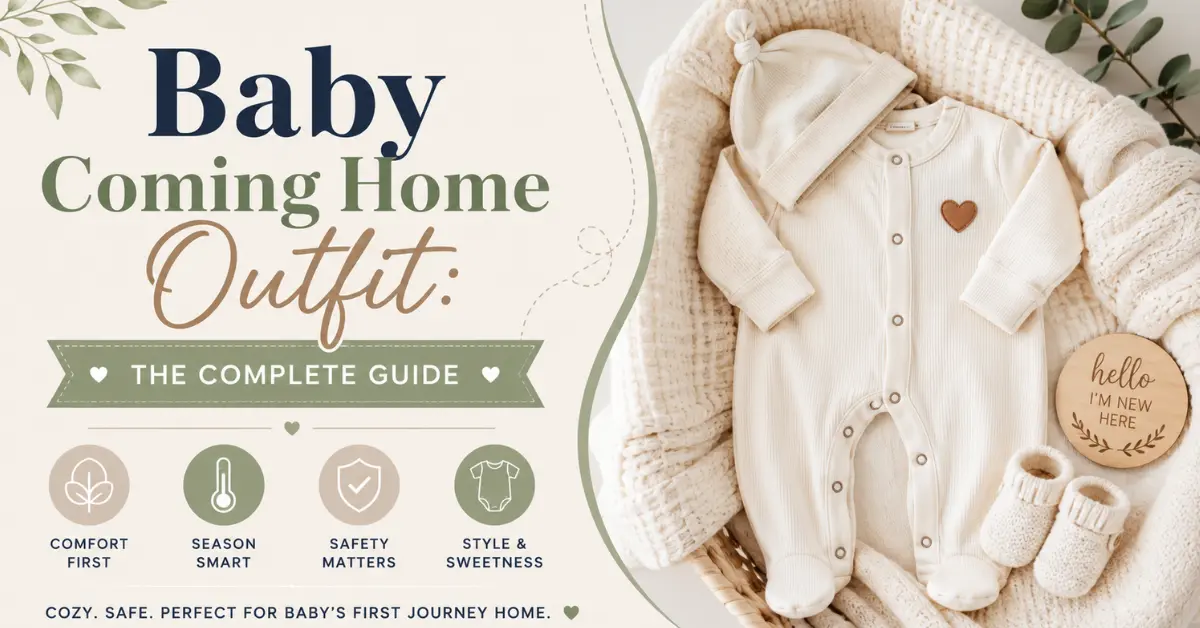
There’s a moment every new parent pictures before the baby even arrives — walking out of those hospital doors, tiny human in arms, dressed in the most thoughtful outfit you could find. The baby coming home outfit is one of the first real decisions you make as a parent, and it carries more weight than most people expect.
This guide walks you through everything: what styles actually work, which fabrics matter for newborn skin, how to size correctly, and the practical details that most articles skip entirely.
What Makes a Baby Coming Home Outfit Different From Regular Newborn Clothes?
A hospital going-home outfit isn’t just any baby outfit. It needs to serve a very specific set of conditions:
Car seat compatibility
The outfit must lay flat enough under car seat straps with no bulky padding, hoods, or back buttons that interfere with the harness.
Cord stump access or clearance
The umbilical cord stump, which falls off between 1–3 weeks, needs to stay dry and unbothered. Waistbands that press against it can cause irritation or slow healing.
Nurse-friendly design
In the hours before discharge, nurses need to check vitals, attach ID bands, and do skin assessments. Snap closures and kimono wraps make this infinitely easier.
Photo-worthy appearance
Let’s be honest — the coming home moment gets photographed extensively. The outfit should look sweet and intentional, not wrinkled or floppy.
Temperature regulation.
Hospital lobbies, parking garages, and car rides can be much cooler than the maternity ward. Layering options matter.
The 5 Best Styles for a Baby Coming Home Outfit
1. Knot Gown (Most Popular)
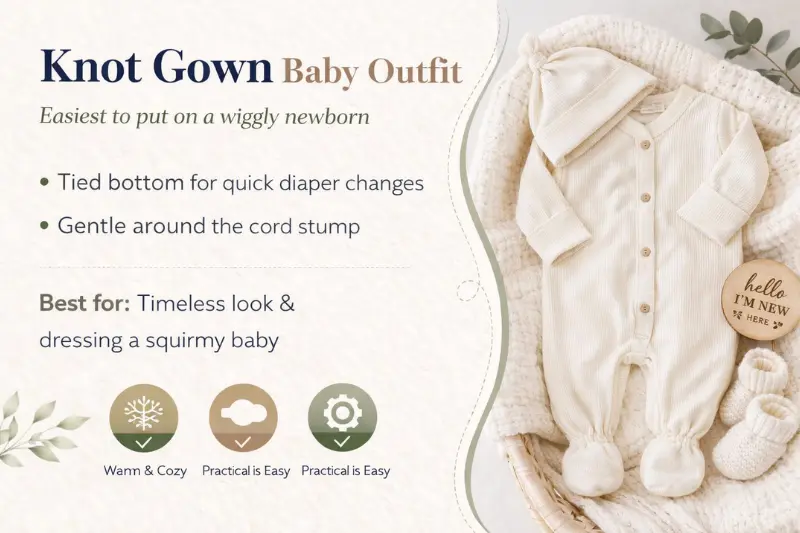
A knotted gown has a tied bottom that opens like an envelope, making diaper access simple. These are the most common type of baby coming home outfit for a reason — they’re fast to put on a wriggly newborn, they’re gentle around the cord stump, and they photograph beautifully. Look for gowns paired with a matching knotted hat for a cohesive look.
Best for: Parents who want ease of dressing and a classic, timeless look.
2. Kimono-Style Set (Best for Cord Stump Safety)
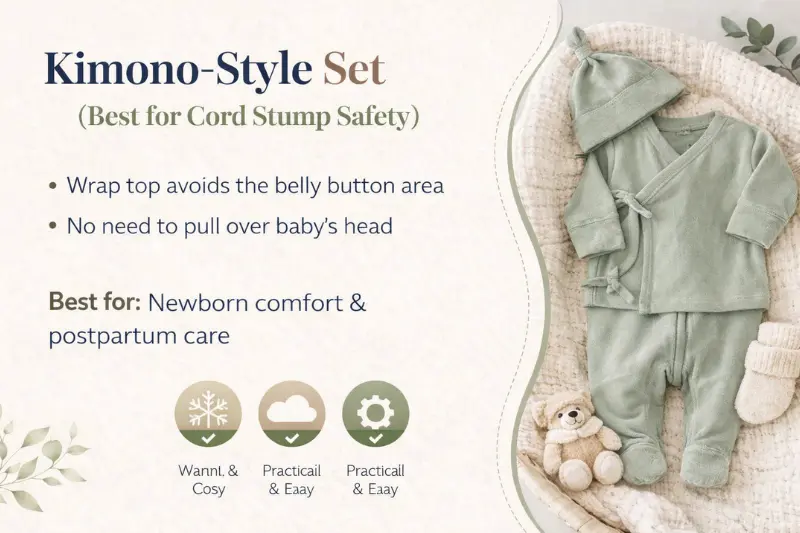
A kimono top crosses over the front of the baby’s body and fastens at the side, so nothing goes over the baby’s head and nothing presses against the belly button area. Brands like Kyte Baby have made this their signature design specifically because of how cord-stump-friendly it is. Paired with footed pants and a knot cap, it makes a complete, functional baby coming home outfit.
Best for: Parents focused on newborn comfort and easy postpartum care.
3. Footed Sleeper (Most Practical)
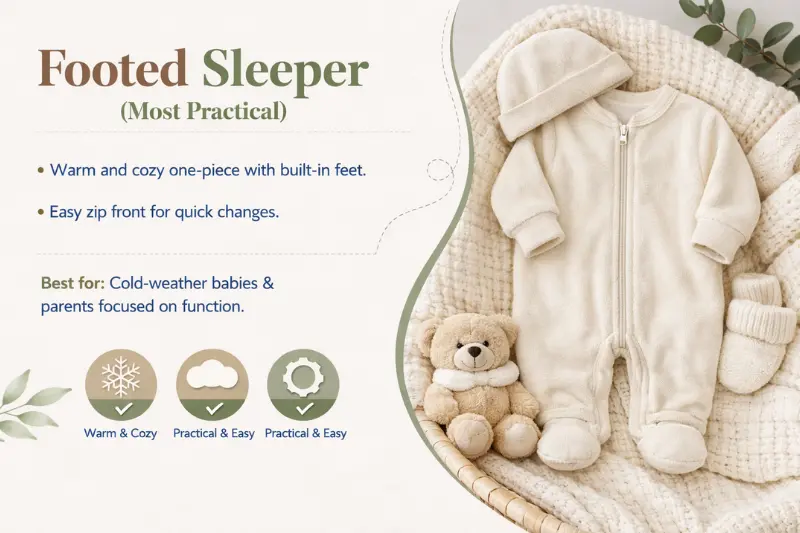
A zip-up or snap footed sleeper is warm, covers everything, and requires minimal fussing. If your due date falls in autumn or winter, a footed sleeper can be the most sensible baby coming home outfit choice — no separate socks to lose, no separate hat to hunt for. Choose a front-zip version rather than a back-snap for ease.
Best for: Cold-weather births; parents who prioritize function over formality.
4. Layering Set (Most Versatile)
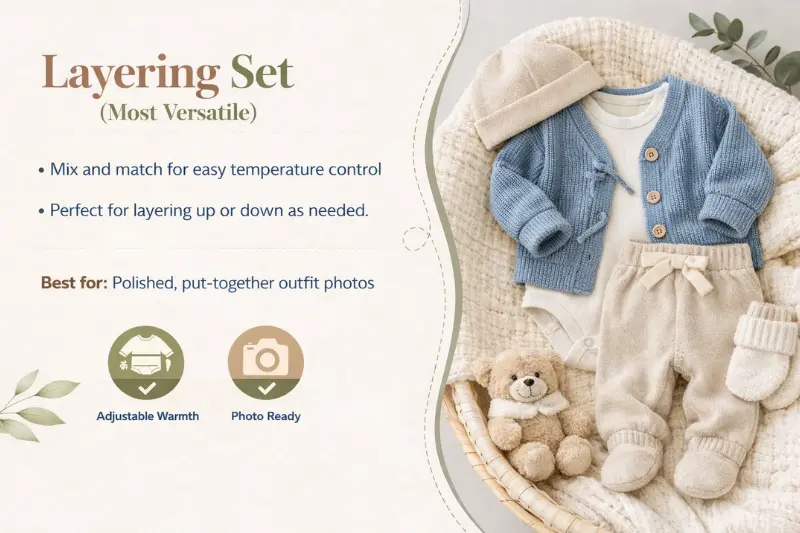
A two- or three-piece layering set — typically a bodysuit, pants, and a cardigan — gives you flexibility. You can add or remove layers depending on how warm the car is. This style works well across seasons and gives a polished look for photos without being fussy.
Best for: Parents who want outfit photos that look intentional and put-together.
5. Heirloom Gown (Most Special)
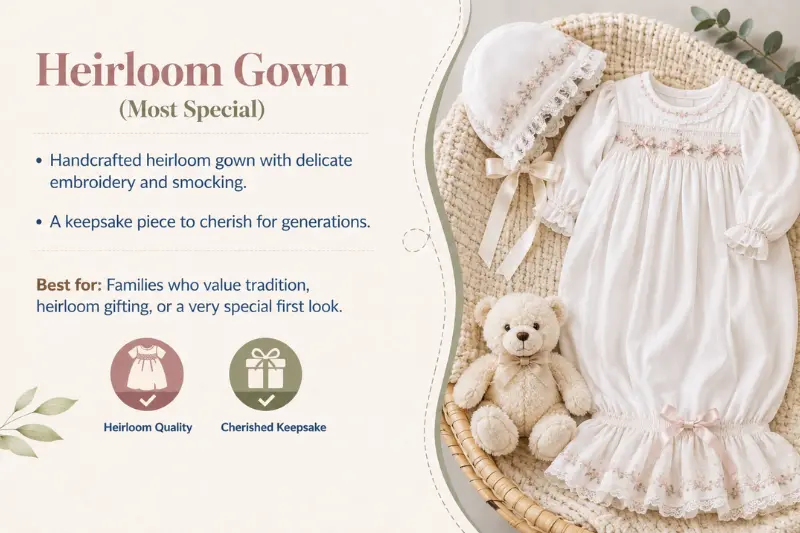
If your family has a tradition of coming home in a smocked or embroidered gown — or you simply want something that feels like a keepsake — a handcrafted heirloom gown is its own category. These run higher in price ($60–$100+) but many families save them for decades. Brands like Feltman Brothers specialize in exactly this kind of handmade baby coming home outfit.
Best for: Families who value tradition, heirloom gifting, or a very special first look.
The Fabric Guide No One Gives You
Fabric choice affects your newborn’s skin more than almost any other factor. Newborns have skin that’s 20–30% thinner than adult skin, according to pediatric dermatology research, making them significantly more reactive to synthetic fibers, dyes, and rough textures.
Bamboo viscose (rayon from bamboo
Extremely soft, temperature-regulating, and hypoallergenic. Ideal for babies with sensitive skin. Common in mid-to-premium brands like Kyte Baby and Posh Peanut. One consideration: it’s a processed fiber, not a raw natural one, so “bamboo” doesn’t automatically mean “chemical-free.”
GOTS-certified organic cotton
The gold standard for chemical safety. “GOTS” (Global Organic Textile Standard) certification means both the cotton and the dyeing process meet strict environmental and safety standards. This is the fabric to look for if skin sensitivity or eczema risk is a concern. Brands like Colored Organics specialize here.
Pima cotton
A long-staple cotton variety that’s noticeably softer than standard cotton. Common in heirloom-style gowns. Breathable, durable, and gets softer with washing.
Standard cotto
Perfectly fine for most babies. Look for a thread count above 200 for softness. Avoid polyester blends for newborns — they trap heat and can irritate reactive skin.
Avoid
Anything with wool directly against the skin, rough embroidery on the inside, scratchy lace, or synthetic fleece for newborns.
Sizing: The Mistake Almost Everyone Makes
Here’s what no one tells you: newborn size fits babies up to approximately 8–9 lbs. If your baby is born above average weight (the global average is around 7.5 lbs, but many babies are born at 8–9 lbs), they may fit newborn size for only days — sometimes hours.
What to do:
- Pack both newborn and 0–3M sizes in your hospital bag. You can return the one that doesn’t fit.
- Note your baby’s estimated birth weight from your last ultrasound and size accordingly.
- If you’re expecting a large baby (9 lbs+), skip newborn size entirely and go straight to 0–3M.
- Premature babies need preemie-specific sizing. Standard newborn clothes will be dangerously oversized. Feltman Brothers offers one of the most complete preemie ranges available.
A practical sizing cheat sheet:
| Baby’s Weight | Recommended Size |
|---|---|
| Under 5 lbs | Preemie |
| 5–8 lbs | Newborn |
| 8–12 lbs | 0–3 months |
| 12+ lbs | 3 months |
Car Seat Safety and the Coming Home Outfit
This is the detail most style-focused articles completely ignore, and it’s actually the most important one.
The AAP (American Academy of Pediatrics) advises:
- No puffy coats, thick hoodies, or bunting bags inside a car seat — they compress in a crash and create dangerous slack in the straps.
- The harness should pass the pinch test (you can’t pinch any slack) with only the outfit between baby and straps.
- Back-button closures can dig into a baby’s spine through a car seat.
The safest baby coming home outfit choices for car travel are fitted knit fabrics — kimono sets, footed sleepers in soft knit, and thin layering sets. You can always add a blanket over the top of the harness (never tucked underneath) for warmth.
What to Pack for the Trip Home: The Full List
Beyond just the baby coming home outfit itself, you’ll want:
- Matching or coordinating hat — hospitals provide a basic beanie, but a matching hat elevates the look
- Swaddle blanket — for layering over the car seat (never under the straps)
- Backup outfit — in a different size, in case of blowouts or sizing surprises
- Mittens — newborn nails are sharp and babies scratch their own faces constantly
- Nursing pillow or nursing-friendly nursing top for the parent, if breastfeeding
Personalization: Worth It or Overhyped?
Personalized baby coming home outfits — with the baby’s name embroidered or printed — have become enormously popular in recent years. Brands like Caden Lane have built their entire model around this.
The honest answer: personalization adds meaningful sentimental value and makes for stunning newborn photos, but it comes with one real drawback — you need to know the name before birth, or you’ll need a 3–5 business day turnaround that may not align with your due date. If you’re planning a personalized baby coming home outfit, order at least 3–4 weeks early and have a confirmed name ready.
Questions to Ask Before You Buy
Before finalizing any baby coming home outfit, run through this quick checklist:
- [ ] Is it easy to put on a squirmy newborn (no over-the-head required)?
- [ ] Does the waistband sit above or below the belly button (cord clearance)?
- [ ] Is it car seat safe — no bulky padding or back closures?
- [ ] Is the fabric certified or tested for newborn skin safety?
- [ ] Do I have the right size based on estimated birth weight?
- [ ] Is there a backup outfit packed in a different size?
- [ ] If personalized — have I ordered early enough?
The One Thing Most Parents Wish They’d Known
Ask any parent who’s already been through it and they’ll tell you the same thing: the outfit you carefully planned may not be the one your baby wears home.
Babies are born with vernix, may have jaundice lights attached, may need blood sugar monitoring. Your perfect baby coming home outfit might spend an extra day in the bag while the hospital-provided onesie does the job. That’s not failure — that’s reality.
Pack the outfit you love. Have a backup. Know your baby’s estimated size. And give yourself permission to care about both the practicality and the beauty of the moment. The picture you take leaving that hospital will matter to you for the rest of your life.
Final Recommendations by Budget
Budget (under $25): Carter’s 4-piece layering sets consistently deliver value without sacrificing softness. Their Little Planet organic line gives you a cleaner fabric option in the same price range.
Mid-range ($30–$60): Kyte Baby’s bamboo kimono take-me-home set is genuinely one of the best-designed coming home outfits on the market — functional, safe, and beautiful. Caden Lane is the pick if you want personalization.
Premium ($60–$100+): Feltman Brothers for heirloom quality and preemie coverage. Posh Peanut for trend-forward looks with licensed character options.
Eco-conscious: Colored Organics for certified organic cotton in gender-neutral, muted tones.
Here are 10 FAQs to add to your article — written to match natural search questions and structured for Google’s “People Also Ask” box:
FAQs: Baby Coming Home Outfit
When should I buy a baby coming home outfit?
Buy it by week 34–36 of your pregnancy. This gives you time to wash it (new baby clothes should always be washed before wearing), sort out sizing, and order a personalized version if needed. Leaving it to the last minute risks running into stock issues or missing the personalization lead time.
What size should I get for a baby coming home outfit?
Pack both newborn and 0–3M sizes in your hospital bag. Newborn size fits babies up to roughly 8–9 lbs. If your baby is measuring large on ultrasound, go straight to 0–3M. You can always return the unopened size. Many parents regret buying only newborn size and find it’s already snug on day one.
What fabric is best for a baby coming home outfit?
For most babies, soft cotton, bamboo viscose, or Pima cotton are the best choices. If your baby has a family history of eczema or skin sensitivity, look for GOTS-certified organic cotton, which means both the fiber and the dyes meet strict safety standards. Avoid polyester blends and anything with rough interior seams directly against the skin.
Can a baby wear a coming home outfit in a car seat?
Yes, but the outfit itself matters for safety. Avoid anything bulky — thick hoodies, padded bunting suits, or coats — because these compress in a crash and create dangerous slack in the harness. The safest choice is a fitted knit outfit like a kimono set or footed sleeper. You can place a blanket over the harness straps for warmth, but never tuck anything between the baby and the straps.
Should the baby coming home outfit be gender-neutral?
It’s entirely a personal choice. Gender-neutral options in ivory, sage, oatmeal, or grey work beautifully and are practical if you’re keeping the sex a surprise until birth, or want to reuse the outfit for a future baby. That said, pink and blue remain the most popular choices and there’s nothing wrong with leaning into them if that’s your style. Buy what feels right for your family.
Do I need to wash the baby coming home outfit before use?
Yes, always. New baby clothes may contain finishing chemicals, fabric softeners used in manufacturing, or dust from storage and shipping. Wash the coming home outfit before packing your hospital bag using a fragrance-free, dye-free detergent. This is especially important for newborns with sensitive skin or a family history of allergies.
What should I avoid in a baby coming home outfit?
Avoid back-snap or back-button closures (they dig into a baby’s spine in a car seat), hoods or strings near the face, scratchy interior embroidery, synthetic fabrics that trap heat, and anything that pulls over the head if the cord stump is still attached. Also skip anything with loose accessories like bows or decorative buttons that could come detached.
How much should I spend on a baby coming home outfit?
You don’t need to spend a lot to get a great outfit. Quality options exist at every budget — Carter’s and similar brands offer soft, well-made sets for $15–$25. Mid-range brands like Kyte Baby run $40–$55 for a complete set. If you want something heirloom-quality or personalized, expect $60–$100+. The outfit doesn’t need to be expensive to be meaningful.
Is a personalized baby coming home outfit worth it?
For many parents, yes — especially for first photos and keepsakes. A name-embroidered gown or printed knot set makes for stunning newborn photos and something you’ll likely keep for years. The main consideration is timing: personalized items typically take 3–5 business days to produce, so order at least 3–4 weeks before your due date and have your baby’s name confirmed in advance.
What happens if the baby coming home outfit doesn’t fit?
It’s more common than you’d think. Pack a backup outfit in a different size so you’re covered either way. If the outfit you packed goes unworn — because of sizing, medical monitoring, or simply because discharge day got messy — don’t stress it. Many parents end up carrying their baby out in a hospital-provided onesie and taking outfit photos at home. The milestone still counts.
Conclusion
The perfect baby coming home outfit comes down to three things: soft, skin-safe fabric — the right size for your baby’s actual birth weight — and a design that works safely in a car seat. Everything else is personal preference.
Pack two sizes, wash it before you go, and keep a backup in your hospital bag. The rest will fall into place.
And if the outfit stays in the bag longer than planned? That’s parenthood. The moment you walk out of those hospital doors with your baby is what you’ll remember — not the outfit.