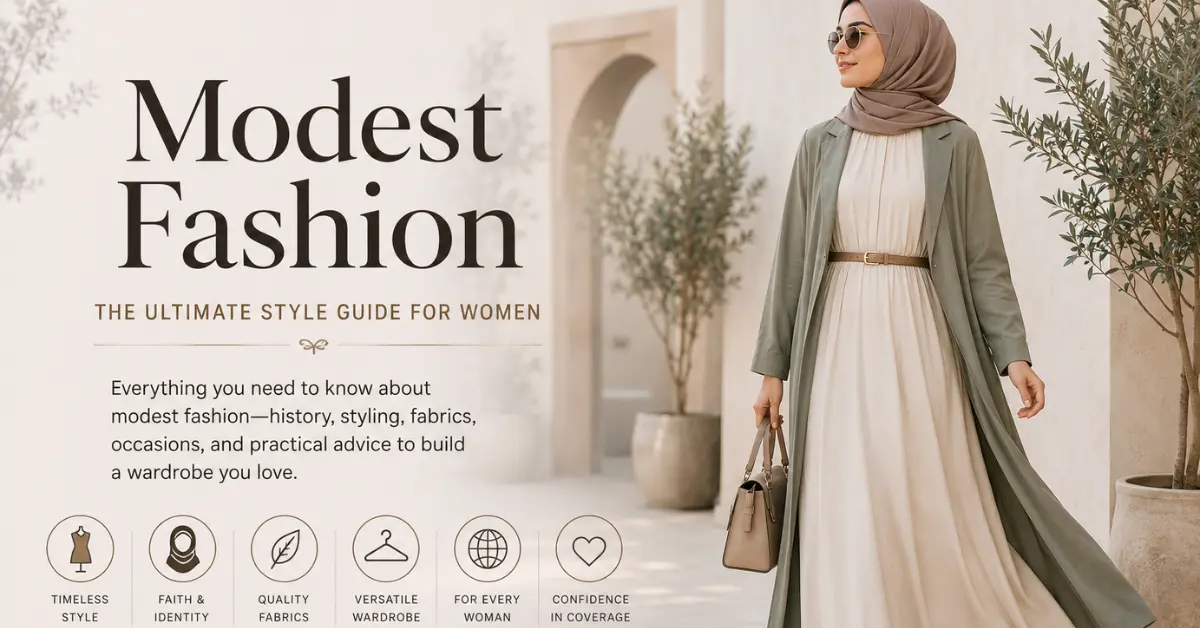
Modest fashion is having a moment — and it is not going away.
What was once considered a niche category has grown into a global movement worth over $350 billion, spanning every culture, faith, and style identity. From runways in Milan to boutiques in Karachi, women everywhere are choosing coverage with confidence — and looking incredible doing it.
This guide gives you everything: the history, the styling rules, the fabrics, the occasions, the faith traditions, and the practical advice that no brand or competitor actually bothers to explain. Read it once and you will know more about modest fashion than most people who have been dressing modestly for years.
What Is Modest Fashion?
Modest fashion describes clothing that provides more coverage than mainstream trends — typically featuring longer hemlines, higher necklines, and relaxed silhouettes. But the definition goes far deeper than fabric and length.
For millions of women, modest fashion is a daily act of self-expression. It bridges faith and identity, culture and creativity. It says: I choose how I present myself, and I do it with intention.
The audience for modest fashion includes:
- Muslim women dressing in accordance with Islamic principles of hijab and modesty
- Christian and Jewish women following faith-based dress standards
- Women of all backgrounds who simply prefer covered, elegant styles
- Modest fashion enthusiasts who love the aesthetic — no religious motivation required
This inclusivity is exactly what makes modest fashion so powerful. It belongs to everyone.
A Brief History of Modest Fashion
Understanding where modest fashion comes from helps you appreciate where it is going.
Ancient roots. Every major civilization valued modesty in dress. From the draped garments of ancient Greece and Rome to the modest robes of medieval Islamic courts, covered dressing has always held cultural significance.
20th century shifts. As mainstream Western fashion moved toward shorter hemlines and more revealing silhouettes from the 1960s onward, modest dressing became increasingly counter-cultural — but never disappeared.
The modern modest fashion movement. The early 2000s saw Muslim women worldwide begin publicly reclaiming their fashion identity, styling hijabs with contemporary clothing and sharing their looks online. By the 2010s, modest fashion had become a recognized global industry.
The mainstream moment. Today, modest fashion is everywhere. Major department stores carry modest collections. Fashion weeks feature modest designers. Instagram and TikTok have made modest fashion creators some of the most influential voices in style.
The Global State of Modest Fashion in 2025
Here are the numbers that tell the story:
- The global modest fashion market is valued at over $350 billion
- Muslim consumers alone represent a fashion market of $277 billion annually
- The market is projected to reach $500 billion by 2030
- Modest fashion searches on Google have increased year over year for eight consecutive years
- Major brands including DKNY, Dolce & Gabbana, and H&M have launched dedicated modest collections
Modest fashion is not a trend. It is an industry.
The 5 Pillars of a Great Modest Fashion Wardrobe
You do not need dozens of pieces. You need the right ones. Build your wardrobe around these five pillars and everything else falls into place.
1. Coverage Basics (Your Foundation Layer)
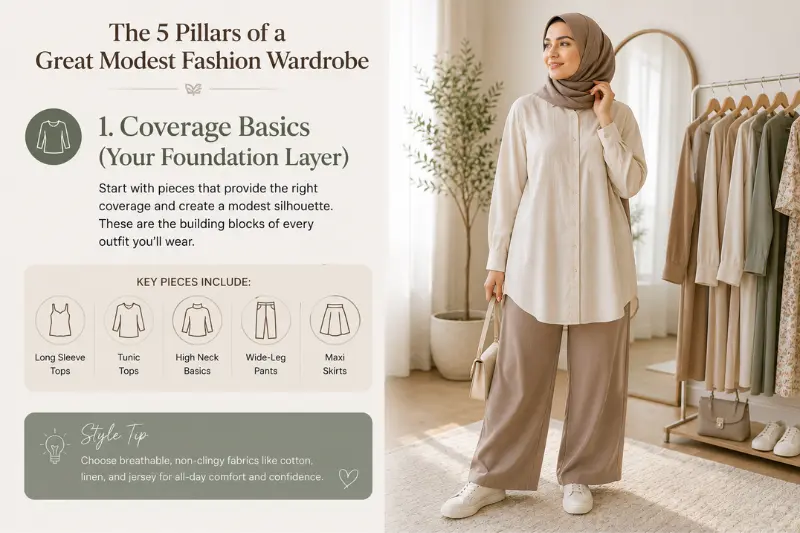
These are the pieces you wear under everything — long-sleeve undershirts, fitted turtlenecks, full-length leggings, and camisoles. Invest in quality here. A good foundation layer transforms any outfit instantly.
What to look for: Breathable fabric (modal, cotton-blend, or bamboo), a snug but not tight fit, and colors that match your skin tone or the outerwear piece.
2. Statement Modest Dresses
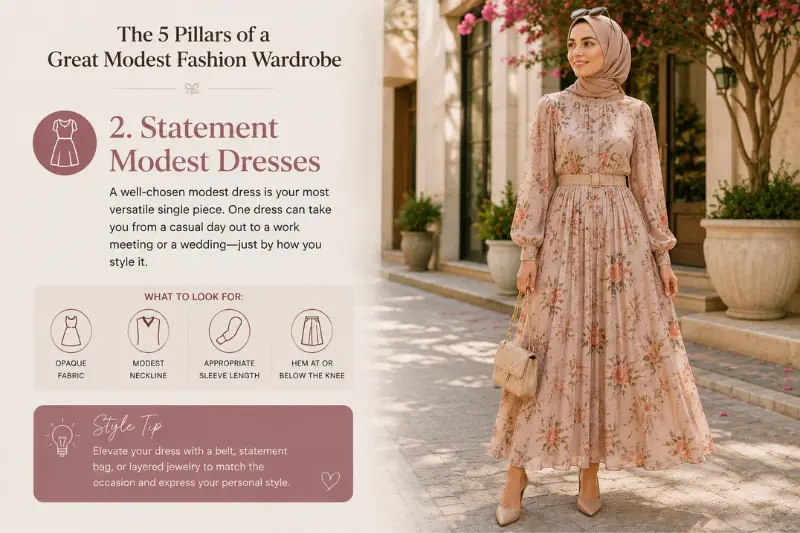
A well-chosen modest dress is your most versatile single piece. One dress can carry you from a casual weekend to a work meeting to a wedding — depending on how you style it.
What to look for: Opaque fabric, a modest neckline, sleeve length that works for you, and a hem that hits at or below the knee (longer for formal occasions).
3. Modest Bottoms (Skirts & Trousers)
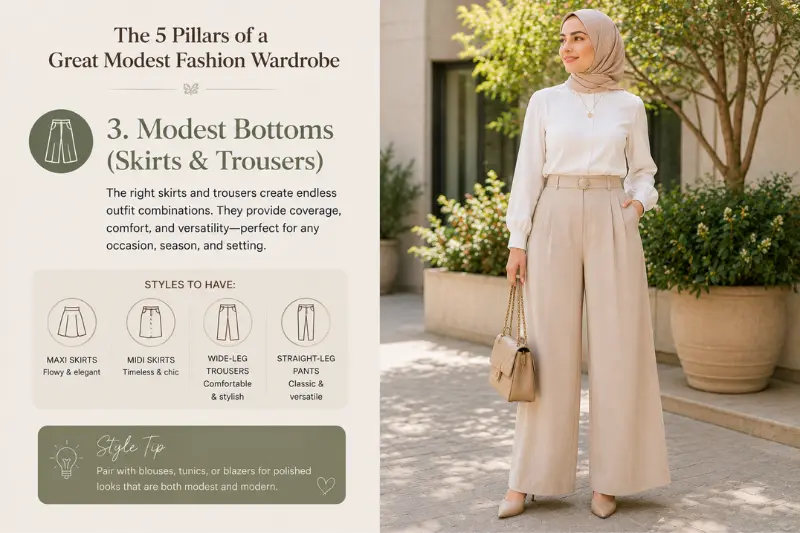
Midi skirts, maxi skirts, wide-leg trousers, and full-length straight-leg pants form the backbone of a modest wardrobe. These mix and match endlessly with tops, blazers, and cardigans.
What to look for: Non-clingy fabrics for skirts (linen, cotton, ponte), structured waistbands, and lengths that suit your lifestyle.
4. Layering Pieces
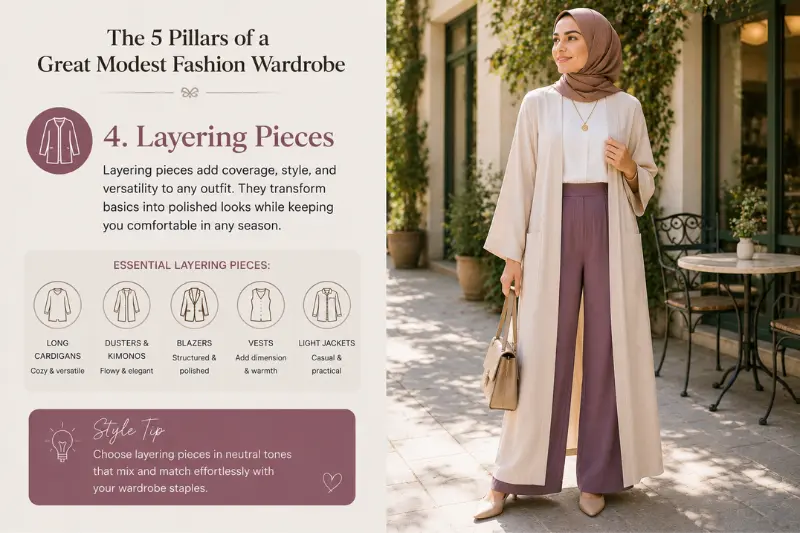
Long cardigans, open-front dusters, structured blazers, and kimono-style jackets add coverage, polish, and personality to any base outfit.
What to look for: Lengths that cover the hip or longer, quality fabric that does not pill, and neutral colors that work across your wardrobe.
5. Occasion-Specific Pieces
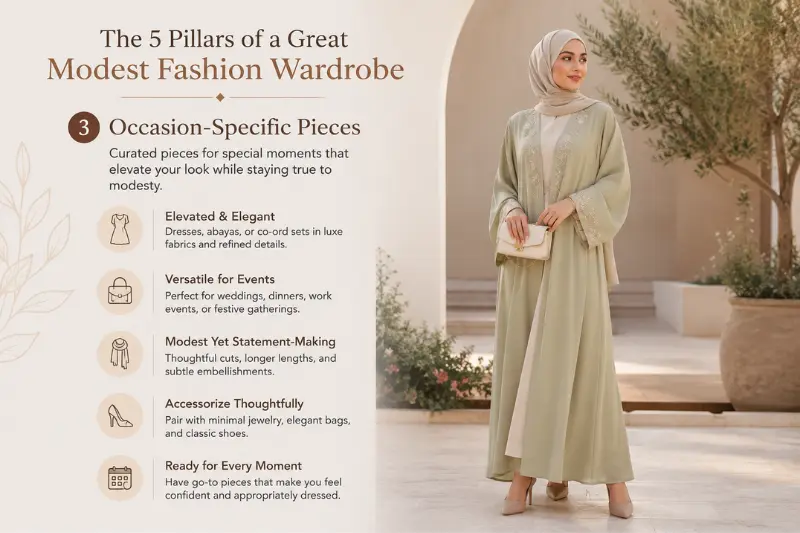
Every wardrobe needs at least one formal modest gown, one modest activewear set, and one modest swimwear option. These are the pieces you reach for in specific situations — and you will be grateful you have them.
Modest Fashion by Faith Tradition
This is the section most fashion brands completely skip — but it matters enormously to the women shopping for modest clothing.
Islamic Modest Fashion (Hijab Fashion)
Islamic modest dress, broadly referred to as hijab, encompasses far more than a headscarf. It is a complete approach to dressing that prioritizes coverage of the body and hair.
Key pieces in Islamic modest fashion:
- Hijab — a head covering in various styles (square, rectangular, wrap-style); popular fabrics include chiffon, jersey, and modal
- Abaya — a full-length, loose-fitting outer garment worn over clothes; available in simple black and increasingly in colorful, embroidered, and fashion-forward designs
- Jilbab — a two-piece outer garment covering the body and hair
- Khimar — a longer head covering that drapes over the chest
- Niqab — a face veil worn by some Muslim women in addition to hijab
- Modest co-ord sets — matching tops and bottoms designed with hijab-compatible necklines and coverage
Styling tips for hijab fashion:
- Match your hijab fabric to the occasion — chiffon for formal events, jersey for everyday wear, sport hijabs for active settings
- Build outfits around a consistent color palette to make mixing and matching hijabs easier
- Structured abayas in rich fabrics (velvet, crepe, jacquard) work beautifully as formal wear without requiring an additional outfit underneath
Christian Modest Fashion
Christian modest dress does not follow a single global dress code — it varies by denomination, community, and personal conviction. Common principles include covering the shoulders, keeping hemlines at or below the knee, and avoiding sheer or form-fitting fabrics.
Popular styles in Christian modest fashion:
- Midi and maxi dresses with sleeves
- Long denim skirts (a staple in many conservative Christian communities)
- Modest bridal and bridesmaid wear
- Prairie and cottagecore aesthetics, which align naturally with modest dressing
- Girls’ modest clothing for young daughters
Bridal note: Modest bridal fashion is a significant and growing subcategory, with many Christian brides seeking long-sleeve gowns, high necklines, and full-length silhouettes.
Jewish Modest Fashion (Tzniut)
Jewish modesty laws, known as tzniut, require married women in many Orthodox and Conservative communities to cover their elbows, knees, and collarbone, as well as their hair (often with a wig, snood, or hat).
Key considerations for tzniut dressing:
- Elbow-length or longer sleeves are standard
- Skirts and dresses at or below the knee
- High necklines covering the collarbone
- Opaque tights when wearing skirts
- Hair coverings in a range of styles from tichels (scarves) to sheitels (wigs) to stylish hats
Modest Fashion Without a Religious Label
Increasingly, women who do not identify with any faith tradition are drawn to modest fashion for its elegance, practicality, and confidence-building qualities. This community is large, growing, and often underserved by brands that position themselves exclusively for religious customers.
If you dress modestly by personal choice, you belong here just as much as anyone else.
Modest Fashion by Occasion
Work and Professional Settings
The office is where modest fashion truly shines. Covered, structured dressing aligns perfectly with professional standards — no second-guessing hemlines or necklines at your morning meeting.
Best modest workwear pieces:
- Tailored wide-leg trousers + a structured long-sleeve blouse
- Midi pencil skirt + fitted blazer
- A wrap dress in crepe or ponte fabric
- Modest trouser suit in a neutral or jewel tone
Avoid at work: Overly casual fabrics (jersey, cotton knit), very loose or oversized silhouettes that read as unpolished, and embellished pieces better suited to evenings.
Casual and Everyday
Modest fashion is not all formal dressing. Relaxed, everyday modest outfits are just as important — and just as stylish.
Easy everyday modest outfits:
- High-waist wide-leg jeans + a long tunic or oversized blouse
- Casual maxi dress with sneakers and a crossbody bag
- A midi skirt with a basic long-sleeve tee and block-heeled sandals
- A linen co-ord set with flat mules
Formal Events and Weddings
Whether you are the bride, a guest, or part of the bridal party, modest formal dressing has never had more options.
Modest formal dressing tips:
- Look for floor-length gowns with long sleeves, cape overlays, or lace details
- Choose luxe fabrics — velvet, silk, chiffon with a satin lining, embroidered georgette
- A heavily embellished modest gown can be its own statement; keep jewelry simple
- For guests: a midi dress in a rich color is almost always appropriate and easily elevated with heels and a clutch
Modest Activewear and Sport
This is the category most brands completely ignore — but it is one of the fastest-growing segments in modest fashion.
What modest activewear looks like:
- Long-sleeve moisture-wicking athletic tops in UV-protective fabric
- Full-length leggings in squat-proof fabric
- Sports hijabs designed specifically for movement — lightweight, breathable, secure
- Modest tennis and golf wear (longer skirts with built-in shorts, polo shirts with collar coverage)
- Burkini swimwear and rash guard sets for water activities
Key features to look for in modest activewear:
- UPF 50+ sun protection for outdoor sports
- Moisture-wicking and quick-dry properties
- Four-way stretch that does not become sheer during movement
- Sports hijabs with chin straps or undercaps for security
Modest Swimwear
Modest swimwear has undergone a revolution. It is no longer limited to dark, shapeless options — today’s modest swim collections are colorful, technical, and genuinely stylish.
Types of modest swimwear:
- Burkini — a full-coverage swimsuit covering arms, legs, and hair; available in lightweight, quick-dry fabric
- Swim sets — a rash guard top paired with swim leggings or shorts
- Modest one-piece — high neckline, longer torso coverage, often with a built-in skirt panel
- Swim skirt + long-sleeve top — a layered approach that allows mix-and-match styling
Maternity Modest Fashion
This is a gap that almost no competitor in the modest fashion space addresses — but pregnant women dressing modestly face unique challenges.
Modest maternity dressing tips:
- Look for empire-waist dresses and tops — they accommodate a growing bump while maintaining modesty
- Stretchy maxi skirts with elastic waistbands are your most comfortable option through all three trimesters
- Wrap dresses in jersey or knit fabric adjust naturally as your body changes
- Layering with a long cardigan or open blazer works through most of the second trimester
- Postpartum: button-front modest tops allow for nursing while maintaining coverage
South Asian Modest Fashion
South Asian modest dressing is its own rich tradition — and one that is almost entirely absent from Western modest fashion conversations.
Key South Asian modest fashion elements:
- Shalwar kameez — a tunic-and-trouser combination that is inherently modest and endlessly versatile; available in casual cotton to formal silk and everything between
- Dupatta — a long scarf that adds coverage and can function similarly to a hijab
- Anarkali suits — flared long tunics worn over fitted trousers, ideal for formal occasions
- Lehenga choli with full-sleeve blouse — a festive choice that is fully modest with the right styling
- Palazzo trousers — wide-leg, full-length trousers that pair beautifully with longer tops
South Asian modest fashion blends color, embroidery, and coverage in a way that Western modest fashion often does not — and it deserves far more recognition in the global modest fashion conversation.
The Fabric Guide Every Modest Fashion Shopper Needs
Fabric is everything in modest fashion. The wrong choice leaves you hot, sheer, or uncomfortable. The right choice makes you look polished and feel good all day.
Best Fabrics for Modest Dressing
| Fabric | Best For | Why It Works |
|---|---|---|
| Cotton | Everyday wear | Breathable, opaque, easy to wash |
| Linen | Summer and warm climates | Lightweight, airy, gets softer with wear |
| Modal | Layering basics | Soft, drapes well, not clingy or sheer |
| Ponte knit | Work and structured pieces | Holds shape, non-sheer, very comfortable |
| Chiffon (lined) | Formal and occasion wear | Elegant and flowy when fully lined |
| Crepe | Professional and formal | Non-wrinkle, structured, elevated look |
| Jersey knit | Casual and activewear | Stretchy and comfortable; check for opacity |
| Bamboo | Activewear and basics | Moisture-wicking, eco-friendly, soft |
Fabrics to Approach with Caution
- Thin polyester — often sheer and uncomfortable in heat; always check in natural light
- Unlined chiffon — beautiful but fully see-through; never buy without a lining or underlayer
- Lightweight jersey — can cling or become sheer when stretched; always test before buying
- Silk — gorgeous but can show the body’s shape; choose a relaxed fit and opaque underlayer
The Opacity Test
Before buying any modest clothing online or in person, always test for opacity:
- Hold the garment up to a bright window or light source
- If you can see your hand clearly through the fabric, it is not opaque enough
- For online shopping: read customer reviews specifically mentioning sheerness, and check if the brand photos are taken in bright daylight (a sheer fabric photograph will not hide it outdoors)
Modest Fashion Styling Rules That Actually Work
These are the practical, hard-won lessons most style guides never share.
Proportion is your most powerful tool.
In modest fashion, because more of your body is covered, proportion becomes the primary visual element. The classic rule: pair a loose top with a more fitted bottom, or a fitted top with a fuller bottom. Never wear oversized on both top and bottom — it obscures your shape entirely.
Invest in your underlayers.
A $10 long-sleeve undershirt worn under everything is one of the most valuable items in your wardrobe. It transforms short-sleeve dresses, makes low necklines wearable, and adds warmth in cooler months. Buy several in neutral shades.
Use a slip for sheer skirts.
A floor-length or knee-length slip in your skin tone or matching the skirt color instantly makes a sheer or semi-sheer skirt fully modest — without buying a whole new piece.
Match your underlayers carefully.
A light-colored dress over a dark undergarment will show through. Always match as closely as possible to either your skin tone or the outer garment’s color.
Color is not your enemy.
Many women default to black, navy, and brown for modesty. But pastels, earth tones, rich jewel colors, and soft florals all work beautifully — and photograph far better than dark basics. Do not limit yourself.
Belting creates structure.
A wide belt at the natural waist over a long cardigan, abaya, or loose dress creates a defined silhouette without adding any skin. It is one of the most effective styling moves in modest fashion.
Dress modestly for the heat.
Loose, breathable fabrics actually keep you cooler than tight, minimal clothing — airflow through fabric regulates body temperature better than direct sun exposure on skin. Linen, cotton, and bamboo in light colors are your best friends in summer.
How to Shop for Modest Fashion Online (Without Getting Burned)
Online shopping for modest clothing comes with unique challenges. Use this checklist before every purchase.
Check the model’s height and build.
A dress hitting mid-thigh on a 5’10” model may be knee-length on you — or shorter. Always look for brands that list model height and measurements, or show the garment on multiple body types.
Read the fabric description carefully.
Words like “flowy,” “lightweight,” and “soft” without the word “lined” can signal sheerness. Look for explicit mentions of opacity, lining, or modesty-friendly construction.
Look at customer-submitted photos.
Real customer images show you how a garment actually looks on a range of body types and in natural light — where sheerness problems become obvious. Prioritize these over professional product shots.
Use the size chart every single time.
Modest clothing often runs slightly larger for coverage reasons. Never assume your usual size transfers between brands. Measure and compare.
Understand the return policy before you buy.
Modest fashion is fit-dependent. Always shop with brands offering at least 30-day returns or free exchanges. If a brand does not clearly state its return policy, that is a red flag.
Read reviews for the specific piece, not the brand.
A brand can be excellent overall but have one poorly constructed item. Read product-specific reviews and look for mentions of coverage, opacity, and true-to-size fit.
Building a Modest Fashion Capsule Wardrobe
A capsule wardrobe is a small collection of versatile pieces that work together to create dozens of outfits. Here is a modest fashion capsule to get you started.
The 14-Piece Modest Fashion Capsule:
- One maxi dress in a neutral (black, white, navy, or camel)
- One maxi dress in a print or color
- Two midi skirts — one casual, one dressier
- Two pairs of wide-leg trousers — one neutral, one in a color or print
- Three long-sleeve tops in neutral shades
- One structured blazer or longline jacket
- One long duster cardigan
- One occasion-wear modest dress or gown
- One modest activewear set
- One modest swimwear piece
From these 14 pieces, you can create well over 30 distinct outfits. That is the power of a thoughtfully built modest wardrobe.
Modest Fashion and Sustainability
One of the most exciting intersections in fashion right now is modest fashion and sustainability — and no one is talking about it enough.
Why modest fashion is naturally more sustainable:
- Longer hemlines and fuller coverage mean more fabric, which encourages investment in quality over quantity
- Covered clothing tends to stay in rotation longer — it is not subject to the same trend cycles as revealing fast fashion
- Modest dressers often develop a more intentional relationship with their wardrobe
What to look for in sustainable modest fashion:
- Natural fibers (organic cotton, linen, Tencel, bamboo)
- Brands with transparent supply chains
- Made-to-order or small-batch production (reduces overproduction)
- Durable construction — look for reinforced seams, quality zippers, and tight stitching
Frequently Asked Questions About Modest Fashion
Is modest fashion only for religious women?
No. Modest fashion is for any woman who chooses it — religious, cultural, or personal preference are all equally valid reasons to dress modestly.
Can modest fashion be trendy?
Absolutely. Wide-leg trousers, midi skirts, linen co-ords, and maxi dresses are all trending in mainstream fashion right now — and all are inherently modest. Modest fashion and current trends overlap more than ever.
How do I dress modestly in a hot climate?
Choose loose, light-colored natural fabrics — linen, cotton, and bamboo are the best choices. Loose silhouettes allow air to circulate around the body, which actually keeps you cooler than tight, minimal clothing.
What is the difference between a hijab and an abaya?
A hijab is a head covering worn by Muslim women to cover the hair and neck. An abaya is a full-length, loose-fitting outer garment worn over clothing to cover the body. Many Muslim women wear both, but they are distinct pieces serving different purposes.
Is modest fashion expensive?
Not necessarily. A small number of quality modest pieces outperforms a large wardrobe of fast-fashion items. Focus on fabric quality and versatility, not quantity. Many accessible brands offer excellent modest basics at reasonable prices.
Can I wear modest fashion to a job interview?
Yes — and you will often be at an advantage. Modest, structured dressing reads as professional, polished, and composed. A tailored blazer, midi skirt, and modest blouse is an excellent interview outfit.
What is the best modest fashion brand for beginners?
Start with a brand that matches your faith background and body type. Look for one that offers easy returns, clear size charts, and a range that includes basics as well as statement pieces. Build your wardrobe gradually starting with core pieces.
Final Thoughts
Modest fashion is one of the richest, most diverse, and most meaningful spaces in the entire fashion world. It spans continents, faiths, cultures, and body types. It is ancient and modern at the same time. And it continues to grow because it serves real women with real lives.